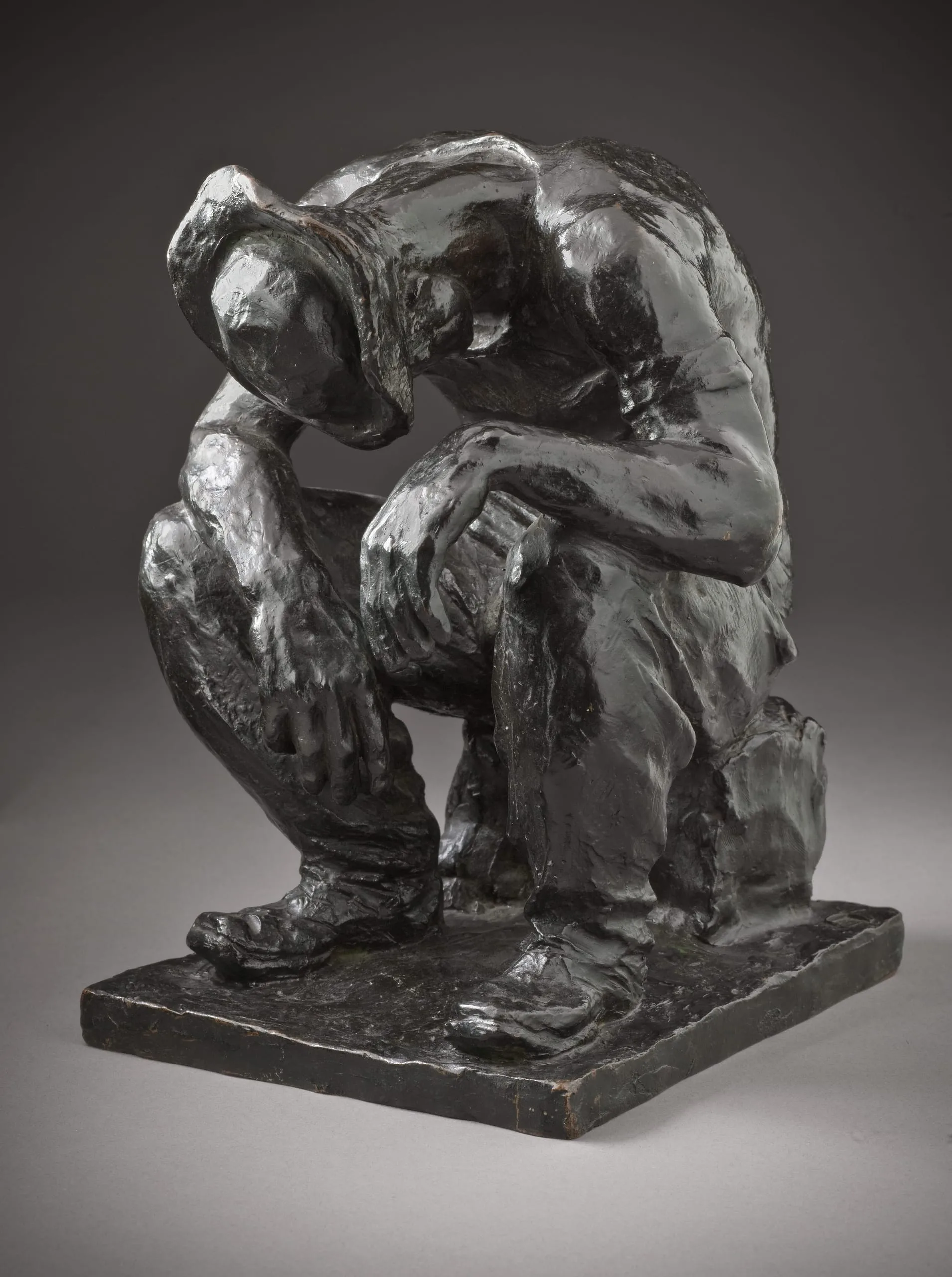
In the spring of 1903 Young modeled his first original works, Tired Out and Laborer (The Shoveler III) (cast of 1908, Sheldon Memorial Art Gallery, University of Nebraska, Lincoln) based on sketches he had made while wandering through the streets of Paris. When the plaster models of the two small pieces were exhibited at the 1903-4 winter exhibition of the American Art Association in Paris, they were enthusiastically noted by the press. This critical attention launched Young’s career.
According to the artist Tired Out was modeled from memory and from small life drawings. It may have been first conceived as part of a larger project, since the figure appears as the top center component in the drawing Monument to Labor, c. 19023 (Provo, Utah, Harris Fine Arts Center, Brigham Young University). Young’s allegorical design was no doubt inspired by the Gates of Hell, begun 1880, by Auguste Rodin (1840-1917); also, the pose of Tired Out was most likely derived from The Thinker, the main figure of Rodin’s Gates. Young transformed Rodin’s contemplative into a man of physical endeavor. The change is most evident in the context of Young’s allegorical design, which is devoted to the theme of labor. As both Tired Out and Laborer appeared in Monument to Labor (the latter as the large, lower-central motif) and were first exhibited together, Young no doubt originally conceived of them as companion pieces. In fact, when they were reproduced in 1904 in the New York Herald (Paris edition) and the Salt Lake Tribune, the figures were given the titles Toil and Rest.
The surface of Tired Out ripples softly throughout, giving an amorphous feeling to the solid mass. Young’s sketchy handling was probably inspired by Rodin. The toiler is dressed in rough, loose, work clothes, his strength conveyed by his oversized hands. Exhausted, and perhaps asleep, his head and shoulders droop down toward his knees. Although at rest, he conveys a power comparable with that of Young’s active laborers, who strain under their physical exertion. Despite its small size, the figure is monumental in conception.
Young’s practice was to cast only one bronze at first and later to cast two or three at a time if needed. Although the sculpture was extensively exhibited in the United States during the first two decades of the century after its showing in the Paris Salon of 1904, the museum’s cast is the only located bronze example of Tired Out. It was cast in Paris, probably sometime between the successful exhibition of the plaster model and Young’s permanent return to the United States in 1905. The casting was done by A. A. Hébrard, a small foundry specializing in the lost-wax technique active around 1900.
The bronze was originally named Tired Out. When the son of Young’s friend Al Wright called it "man tired," the artist decided that the new title better expressed the sentiment he intended.