- Title
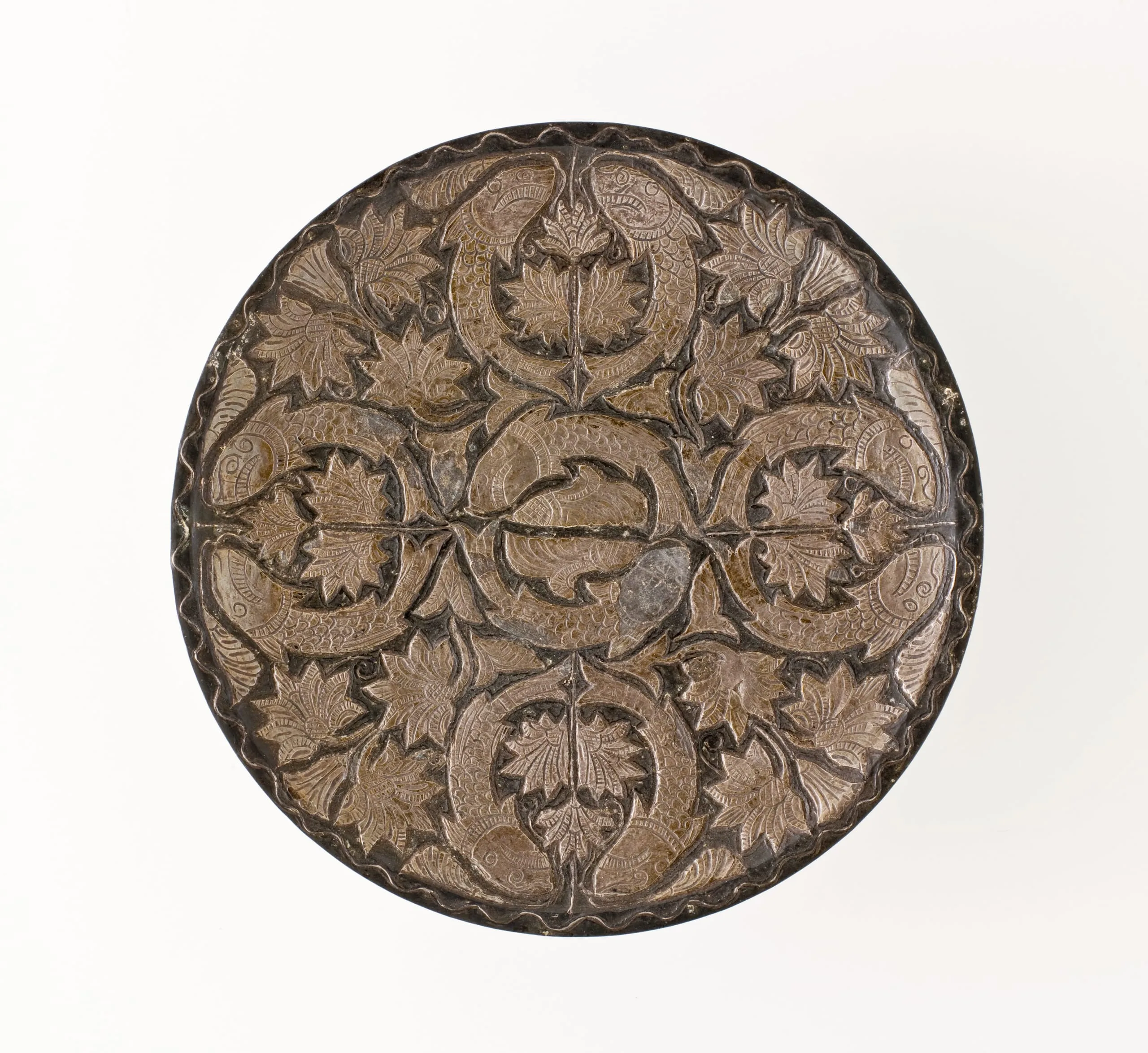
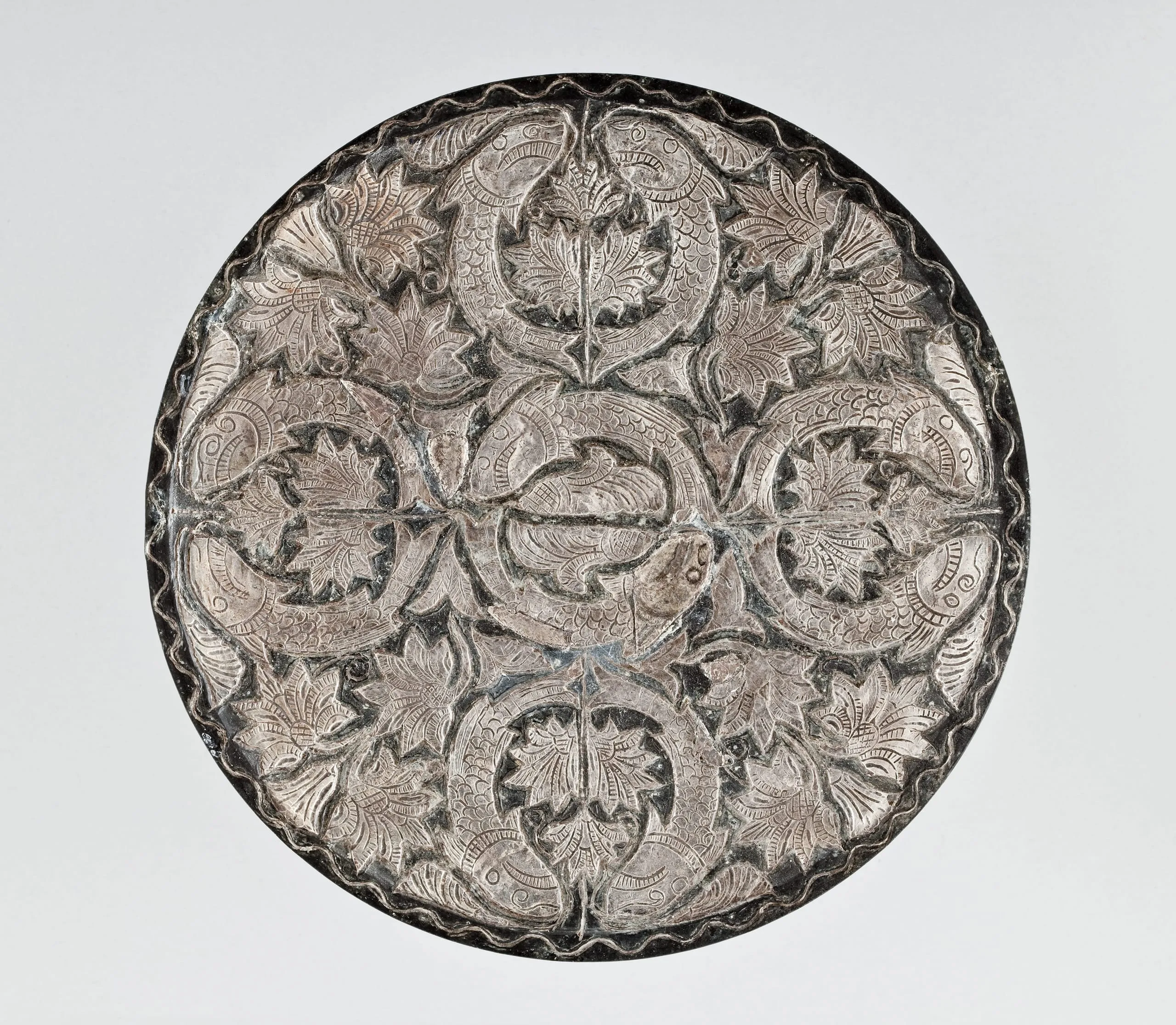
- Plate with Emblematic Pairs of Fish (mahi-ye maratib)
- Date Made
- circa 1880
- Medium
- Bidri-ware (zarbuland technique)
- Dimensions
- Diameter: 6 3/4 in. (17.15 cm); Height: 1/2 in. (1.27 cm)
- Accession Number
- M.2001.100
- Curatorial Notes
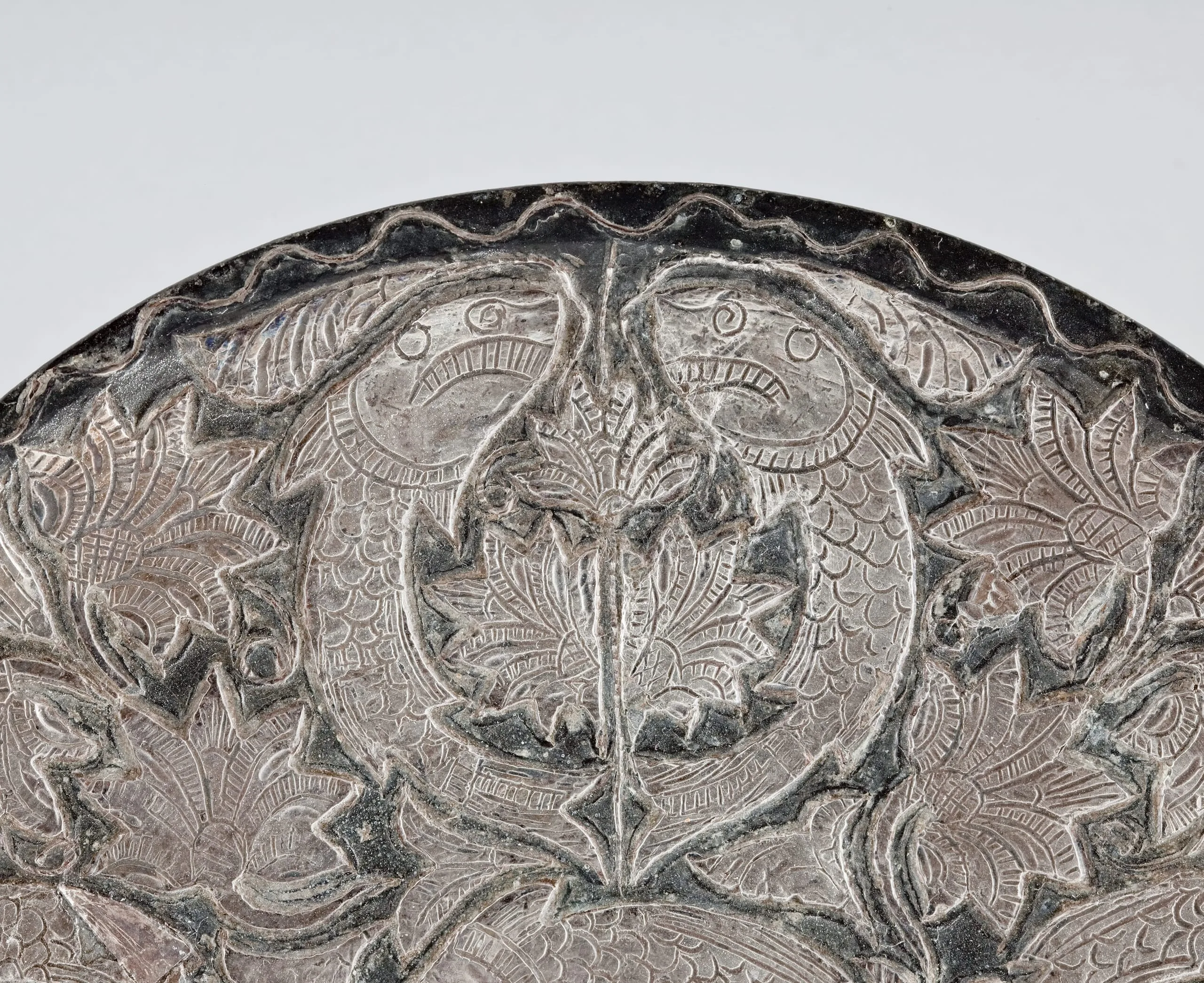
The primary decoration on this bidri ware plate is a pair of fish arranged head-to-head with their curved bodies forming a circle. Known as the mahi-ye maratib (Fish of Dignity), it was an insignia of exalted rank that the Mughal emperors and earlier Middle Eastern rulers bestowed upon their subordinate chieftains in recognition of valorous military service. In 1720 it was awarded by the Mughal Emperor Muhammad Shah (r. 1719–48) to Saadat Khan, the Governor of Akbarabad (Agra), who soon became the Governor of Lucknow from 1722 to 1739. The fish emblem subsequently served as the dynastic leitmotif of the Lucknow court and was frequently displayed on its decorative arts and palatial architecture. It was represented in state processions as a fish and two gilt globes carried on a standard. A heraldic form consisting of a pair of honorific mermaids bearing a crown and flanking a shield was used as the personal coat of arms of King Wajid Ali Shah (r. 1847–56).
Bidri ware is made from a predominately zinc-based alloy, along with smaller amounts of lead, copper, and/or tin. The ornamentation of bidri ware from the Deccan and eastern India typically features inlaid silver sheet or wire designs, which are rendered flush and burnished. Lucknow bidri ware is distinctive in that it is often executed in bold relief (zarbuland technique), in which the inlaid metals are allowed to remain protruding slightly above the surface and are then adorned with sheet overlay and incised motifs.
- Selected Bibliography
- Markel, Stephen & Gude, Tushara Bundu. India's Fabled City. The Art of Courtly Lucknow. Los Angeles County Museum of Art and Del Monico Books- Prestel. Los Angeles, CA. 2010..