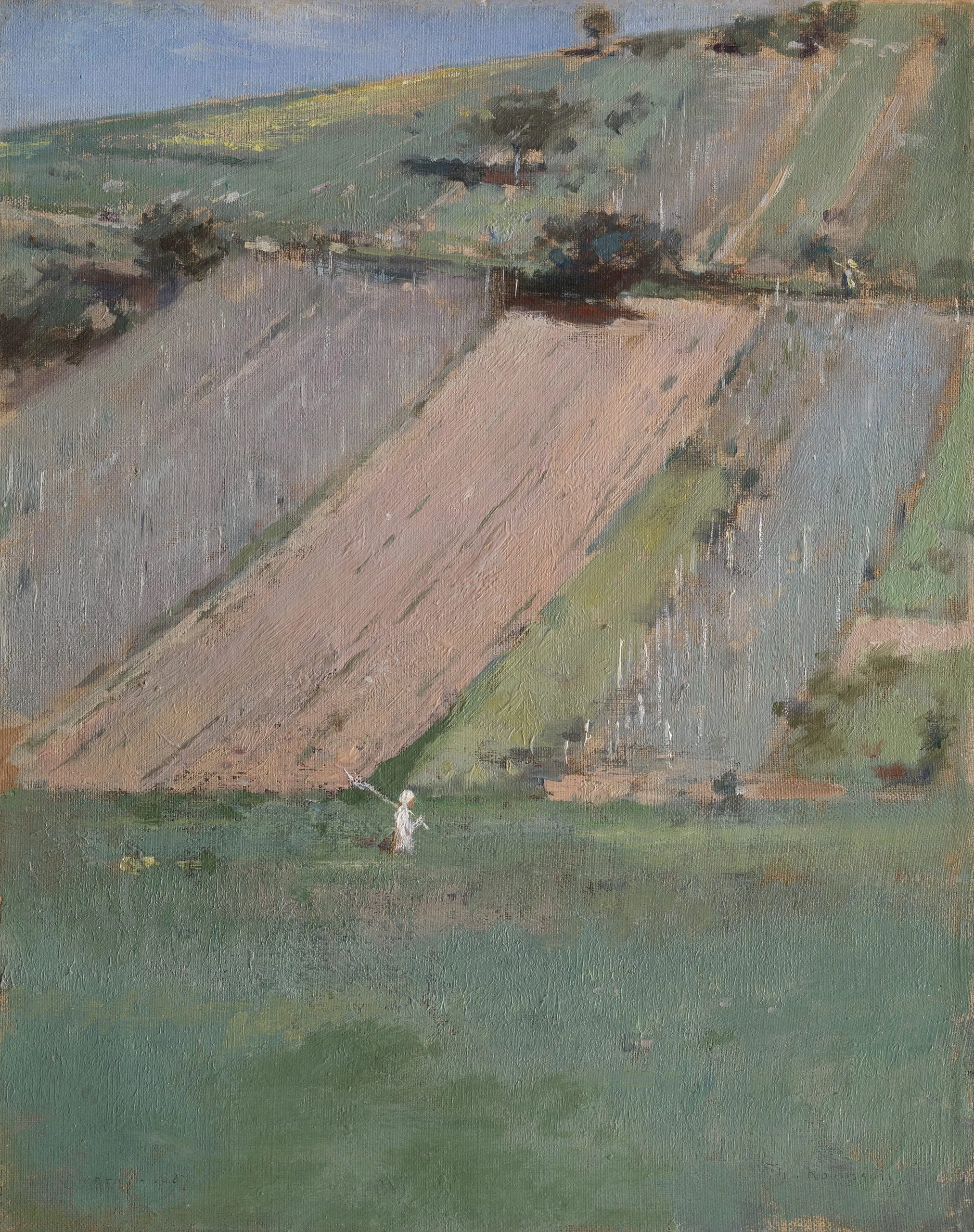
Theodore Robinson (1852-1896) was one of the most important American Impressionist painters. Valley of the Seine, Giverny dates from Robinson’s first encounter with Giverny, the village where Monet had settled four years before. Robinson was one of a group of four American artists who spent the summer there, establishing the art colony that would be the fountainhead of American Impressionism. Of this group, Robinson was the one who worked most closely with Monet; while never formally his student, it was he who absorbed Monet’s principles most thoroughly. At the same time, Robinson, like most American artists of the day, was also strongly influenced by Whistler (whom he had met in Venice in 1879) and the Aesthetic movement, resulting in a persistent interest in surface and pattern. That is to say, Americans adapted French Impressionism to their own interests and aesthetics; American Impressionism ultimately becomes its own movement, independent of its origins in France.
Valley of the Seine, Giverny is a perfect example of this balance. On the one hand, it is a plein-air oil sketch, reproducing one of the topographical features that made Giverny distinctive, the escarpment above the Seine. Our eyes register the brightness of the day, its heat, and the colors of the fields in the broken brushstrokes and pure colors of Impressionist style. At the same time, the most distinctive features of the painting are the large, angular flat lines of the fields that run down the side of the hill and come to an abrupt halt in the horizontal green field below. We read this painting both as a light-filled scene and as a decorative pattern. Indeed, the boldness of the pattern making anticipates the development of the distinctive native modernism that grows out of the teachings of Arthur Wesley Dow and that can be found in the work of O’Keeffe and Dove. In other words, this is a work that rests precisely at the moment in Robinson’s work where he is exploring both the realism of Impressionism and the abstraction of Aestheticism.
Robinson’s Valley of the Seine, Giverny is the Museum’s first work by the first generation of Americans who worked at Giverny. Coming from the initial moment when the colony was founded it is also the Museum’s earliest American Impressionist plein-air oil sketch. The painting complements LACMA’s great Marry Cassatt, Mother About to Wash Her Sleepy Child, 1880, Cassatt’s first enunciation of the theme that would dominate her oeuvre. As Cassatt is to Degas, her mentor who formed her style, so is Robinson to Monet; these two works both reveal this fundamental relationship and suggest how each artist differed from her or his mentor. While the Cassatt is a great exhibition figure painting and the Robinson a small-scale landscaped sketch, nonetheless within the careers of these important artists, the two works occupy similarly pivotal places. Much of what makes Robinson’s later landscapes distinctive – particularly his interest in bold patterns and shapes – is seen here first in a concentrated form.