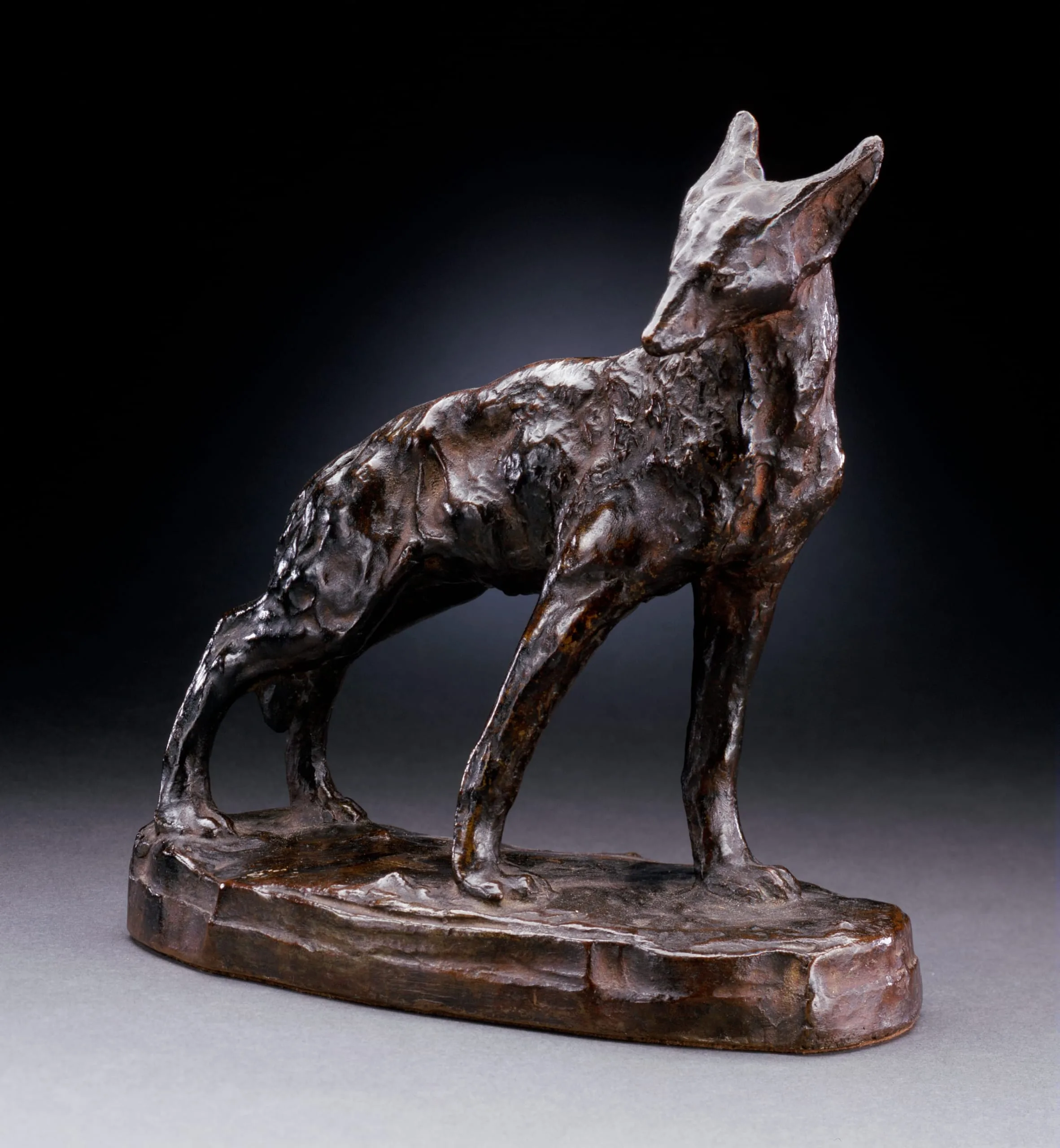
In addition to his larger tabletop bronzes, such as Puma and Deer, which attain a certain monumentality, Putnam modeled numerous smaller, more whimsical bronzes. The public seems to have found these charming, small sculptures irresistible. The dealer R. W. Macbeth wrote to Mrs. Putnam on August 29, 1913, that the small animal figures were what people wanted to buy, and "it is upon those that his fame will very likely depend" (Archiv. Am. Art, Macbeth Gallery Papers, microfilm roll 2622, frs. 1386-87).
Putnam characteristically depicted the animal in an undramatic, habitual stance. The head of the sculpture is somewhat foxlike because of the size of the ears in relation to the width of the rostrum, but the length and thickness of the legs, the stance, the size and position of the tail, and the heaviness of the body are all characteristic of the coyote and not of the fox. Putnam’s intimate knowledge of the animals is sometimes obscured in his smaller bronzes, which were more freely and expressively modeled than many of the larger ones.
The museum’s cast of Coyote bears the foundry mark of Roman Bronze Works. Roman Bronze’s association with Putnam and Macbeth, who may have sold the piece, lasted from at least late 1911 until mid-1914 (examples from 1921 bearing the mark of Rudier, Paris, in the Fine Arts Museums of San Francisco and the San Diego [Calif.] Museum of Art).