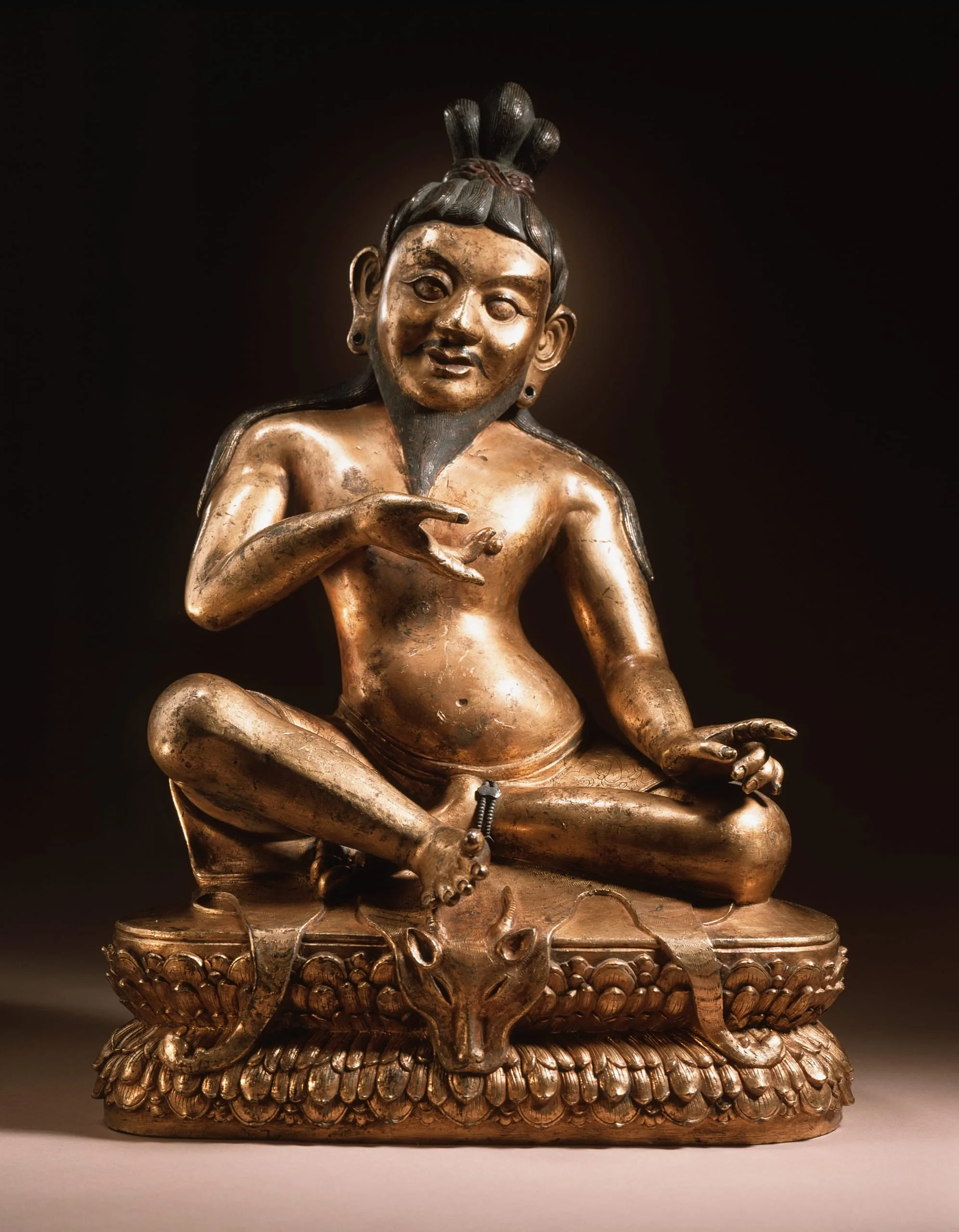
The Mahasiddha (Great Adept) Naropa (956-1040) was a renowned Buddhist monk and teacher who was instrumental in the creation of the principal Kagyu order of Tibetan Buddhism, which was chiefly responsible for the rise of Buddhism in Central Tibet. His birth name was Samantabhadra (Universal Goodness), which he was given because of the numerous auspicious astrological signs that heralded his nativity. He was born a Hindu prince in eastern India, but as a youth went to Kashmir to study Buddhism. At his father's insistence, he returned home to marry a Brahmin woman, but soon became disillusioned with worldly life and renounced it to become a monk. Naropa then returned to Kashmir to continue his Buddhist studies and was eventually appointed the revered abbot and chancellor of the great monastic university of Nalanda in eastern India, which was the leading center of advanced learning in all of Asia for over 500 years. His most important student at Nalanda was Marpa (1012-1097), who founded the Kagyu order based on Naropa's interpretation of Buddhist doctrine. The lineage of the teacher is paramount in Tibetan Buddhism and forms the basis of its organization into the four major orders and several suborders. Naropa's religious teachings and writings are of such seminal significance to the Kagyu order that, even though he never visited Tibet, he is always represented in their painted and sculpted lineage hierarchies along with his master Tilopa and his student Marpa.