- Title
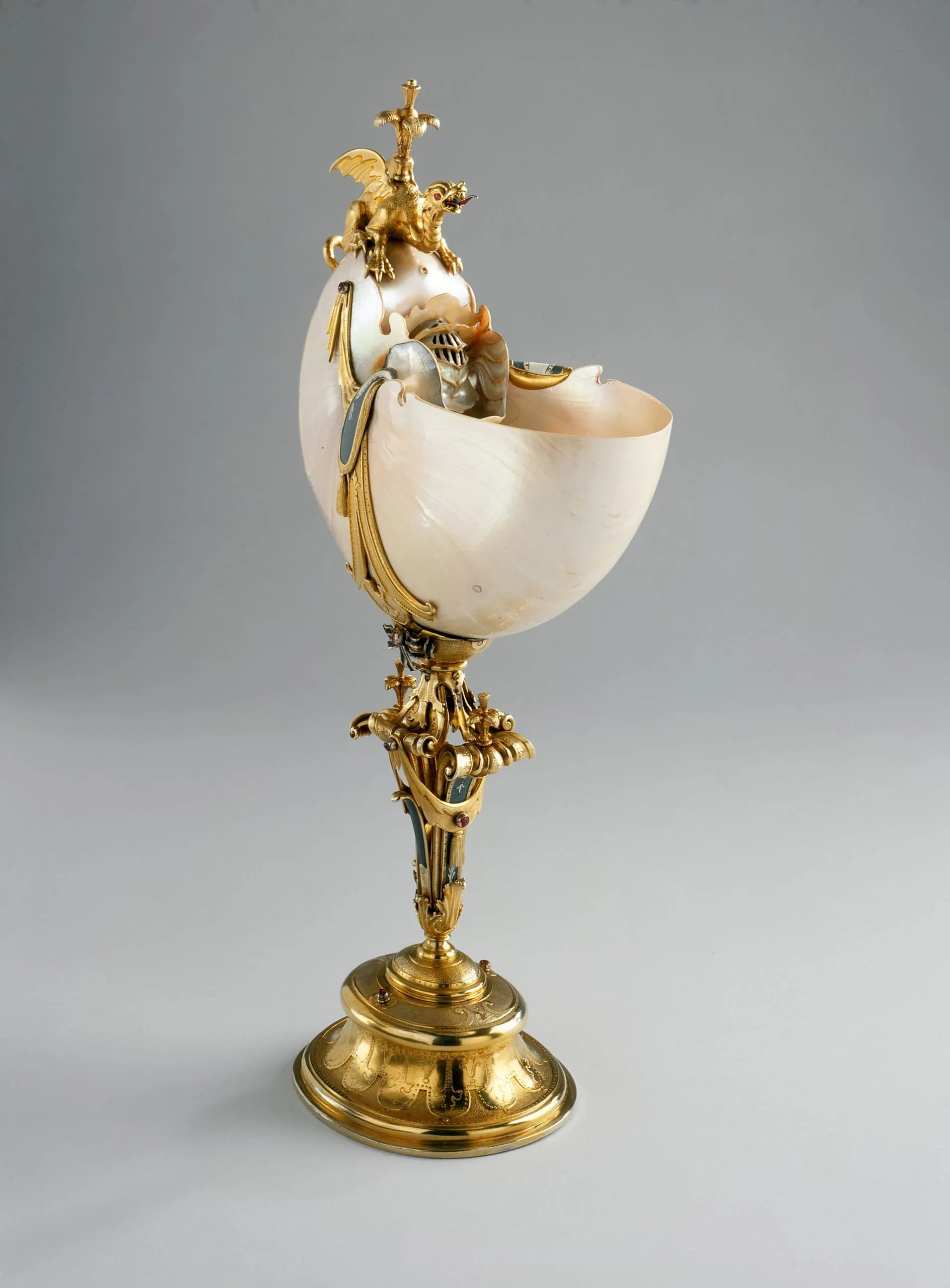
- Nautilus Cup
- Date Made
- circa 1720
- Medium
- Nautilus shell and gilded silver mounts with enamel and gemstones
- Dimensions
- 12 × 6 1/4 × 4 in. (30.48 × 15.88 × 10.16 cm)
- Accession Number
- M.2001.57a-b
- Curatorial Notes
Rooms or cabinets (Kunstkammern) that combined painting, sculpture, scientific instruments, natural specimens, and man-made curiosities were popular among the European elite in the sixteenth and seventeenth centuries. Renaissance collectors understood these cabinets as a miniature universe. Whereas rare and precious crafted objects represented human ingenuity, natural specimens like shells and minerals were admired as divine creations. Such collections reflected the owner’s aesthetic taste and scientific curiosity, and in many ways they were the precursors of modern museums. One of the greatest European art treasuries of this kind was in Dresden, where this cup was made, and where successive rulers of Saxony amassed collections that can still be seen today. The cup is composed of the shell of a chambered nautilus, which was among the most prized natural specimens, widely admired for its perfect spiral geometry and pearly surface. A Dresden goldsmith mounted the shell on a stand of gilt silver embellished with enamel and gemstones. The figure of a winged dragon on top adds an element of fantasy to the shell, which already carried connotations of exoticism as a byproduct of global exploration and trade. The vessel is thus both a natural wonder and a triumph of highly skilled silversmiths and jewelers. It served as a purely ornamental trophy for display. Still popular today with collectors, the chambered nautilus (Nautilus pompilius) is a threatened species due to overfishing.