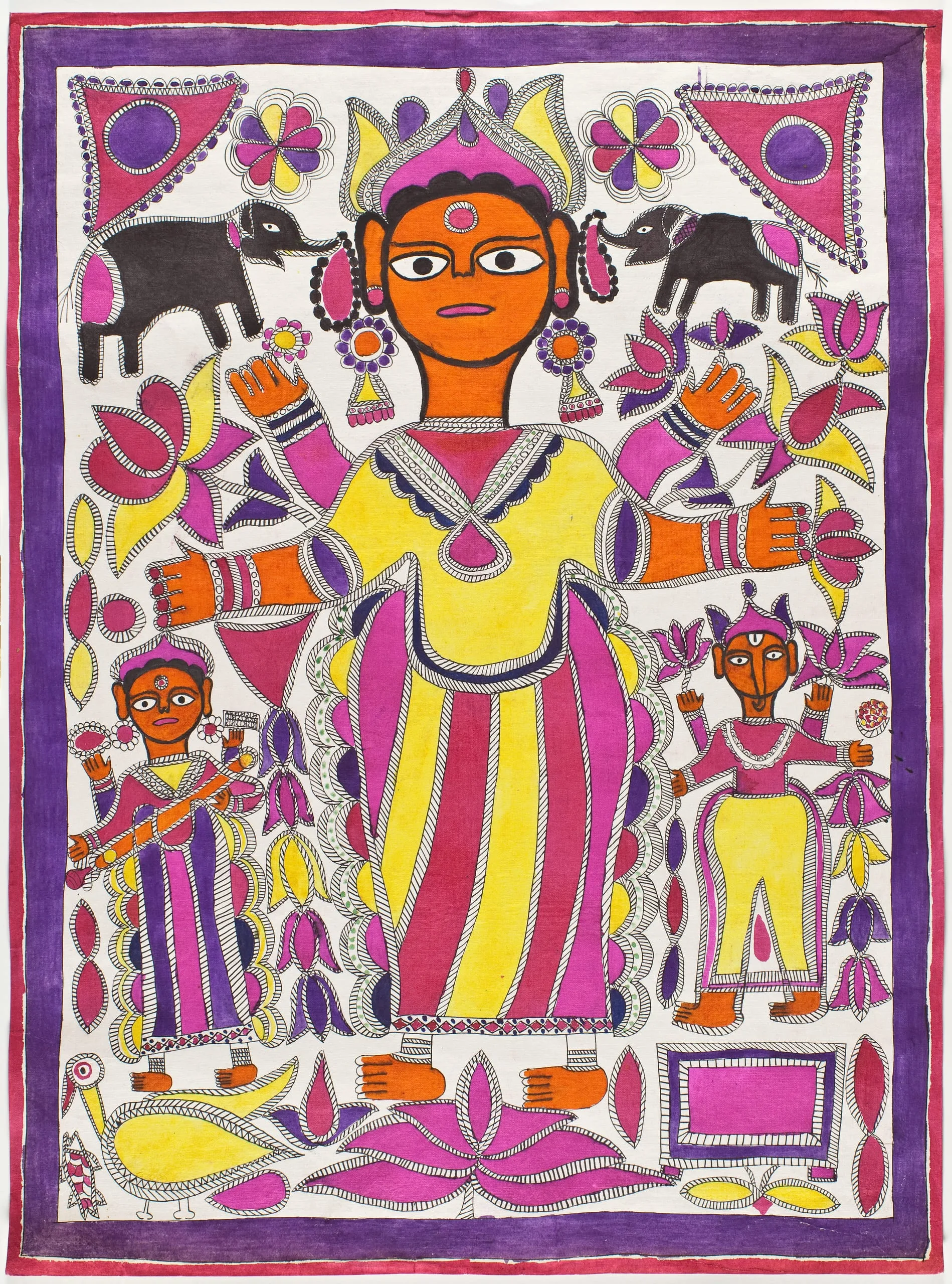
Madhubani or Mithila painting originated in northern Bihar, particularly in the village of Mithila in the Madhubani District, from which the art derived its modern names. Originally, these paintings, marked by their black outlines and striking color combinations, were executed on freshly plastered mud walls and floors of huts. They were collaborative efforts on the part of village women. The traditional imagery of these paintings concerns nature and fertility and is closely tied to events of ritual importance. Walls in family shrines were often painted, and the exterior walls of homes were decorated for weddings and festivals. For marriage celebrations, the nuptial chamber (kohbar ghar) was adorned with images having symbolic as well as auspicious properties.
Mithila artists have also produced paintings on paper since 1966, when a severe drought and famine left the region impoverished. Government aid workers, in an attempt to provide a source of income, encouraged them to transfer their art form to works on paper that could be sold to tourists. Their paintings on paper depict magical and ritual symbols, mythological scenes, folk stories, popular dramas, and images of Hindu deities.
Here, Shri Lakshmi, the Hindu goddess of wealth and beauty, is being lustrated by elephants (gajas) in an iconographic form known as Gaja-Lakshmi. On her right is Sarasvati, the goddess of knowledge, learning, speech, poetry, and music. On her left is the elephant-headed Ganesha, lord of obstacles.