LACMA

ShopMembershipMyLACMATickets
LACMA
Los Angeles County Museum of Art
5905 Wilshire Blvd.
Los Angeles, CA 90036
info@lacma.org
(323) 857-6000
Sign up to receive emails
Subscribe
© Museum Associates 2026
  • About LACMA
  • Jobs
  • Building LACMA
  • Host An Event
  • Unframed
  • Press
  • FAQs
  • Log in to MyLACMA
  • Privacy Policy
© Museum Associates 2026
Collections

Philip Galle (copy after)
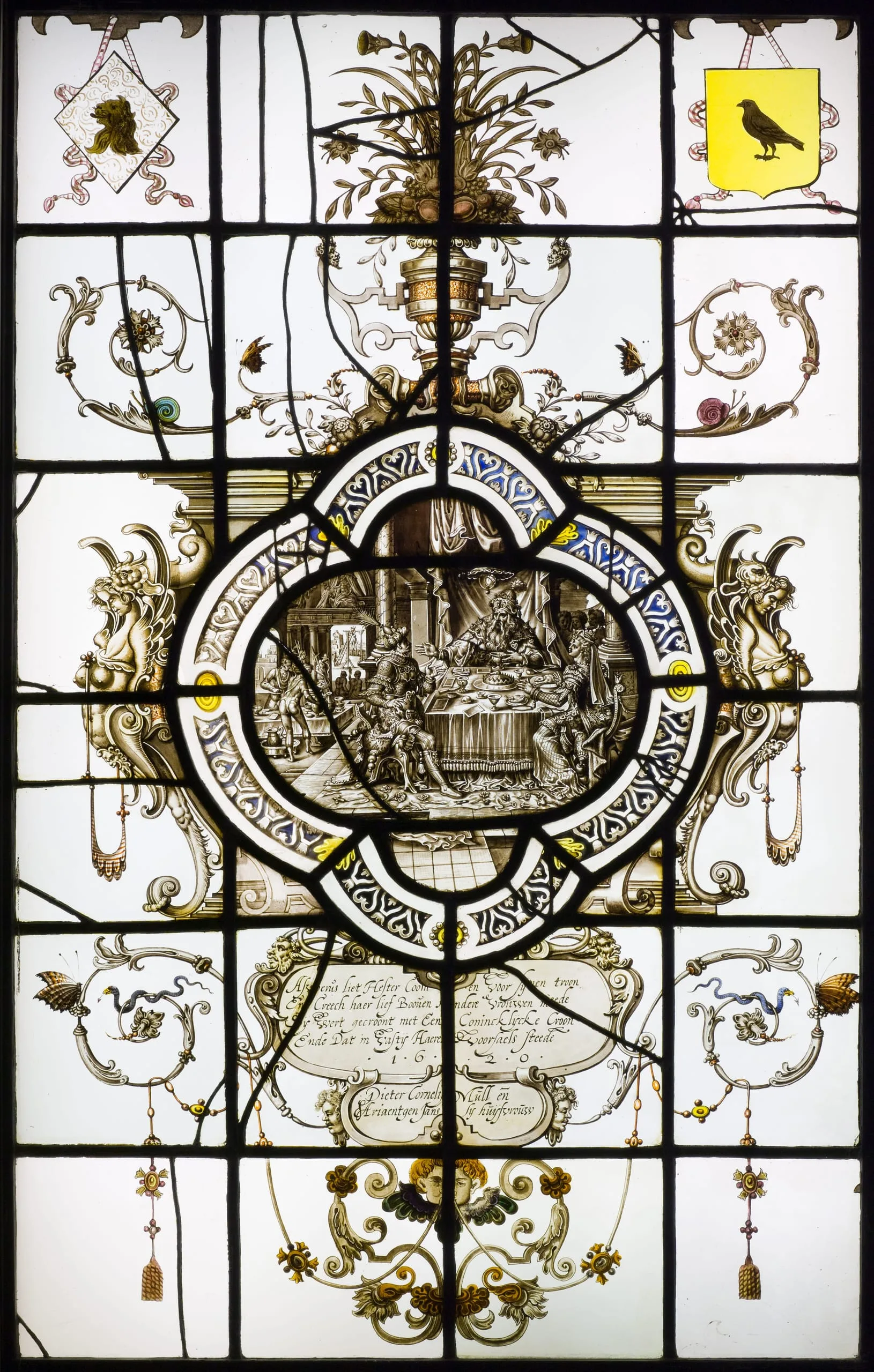
Window with Scene from The Story of Esther1620s

Not on view
Stained glass panel with central grisaille roundel depicting a banquet scene, surrounded by gilded scrollwork, heraldic shield, and a Dutch inscription in a lower cartouche

Philip Galle (copy after), Maerten van Heemskerck (after), Window with Scene from The Story of Esther, 1620s, Los Angeles County Museum of Art, William Randolph Hearst Collection, photo © Museum Associates/LACMA

Artist or Maker
Philip Galle (copy after)
Artist or Maker
Maerten van Heemskerck (after)
Title
Window with Scene from The Story of Esther
Place Made
Netherlands, possibly Haarlem
Date Made
1620s
Medium
White glass, leaded; silver stain; two shades of vitreous paint; sanguine; translucent enamels
Dimensions
38 x 24 in. (96.52 x 60.96 cm)
Credit Line
William Randolph Hearst Collection
Accession Number
45.21.52
Classification
Architecture
Collecting Area
Decorative Arts and Design
Curatorial Notes

The central scene of this window is a reversed version of a 1564 engraving by Philip Galle after a painting by Dutch artist Maerten van Heemskerck. The scene depicts the banquet where the Persian queen Esther reveals her Jewish identity and saves the Jewish people from destruction. With animated gestures, she reveals to King Ahasuerus a plot by Haman, his chief adviser, to kill her and all other Jews in the kingdom. In the biblical Book of Esther, the king rushes to her defense, orders the execution of Haman, and spares the Jews. Visible in the distance are the gallows on which Haman, rather than Esther’s cousin Mordecai, is put to death.

Esther’s heroism held particular meaning for both Jewish and Christian communities in the Netherlands in the seventeenth century. The Dutch Republic, a small Protestant nation, had only recently gained independence from the Catholic empire of Spain. The story of Esther mirrored their hard-won freedom and reflected a culture of religious tolerance. Dutch painters and printmakers also turned to the story of Esther for inspiration. While the original context for this window, part of a larger set, is unknown, the inclusion of individual names in the inscription below the image may have honored patrons who commissioned the windows (see also 45.21.53).
Selected Bibliography
  • Levkoff, Mary L., ed. Hearst the collector. Exh. Cat. New York: Abrams and Los Angeles: Los Angeles County Museum of Art, 2008.
  • Raguin, Virginia Chieffo. Stained Glass before 1700 in the Collections of the Los Angeles County Museum of Art and the J.Paul Getty Museum. Vol. 1, Los Angeles County Museum of Art. London: Harvey Miller Publishers for American Corpus Vitrearum, Inc., 2024.