- Title
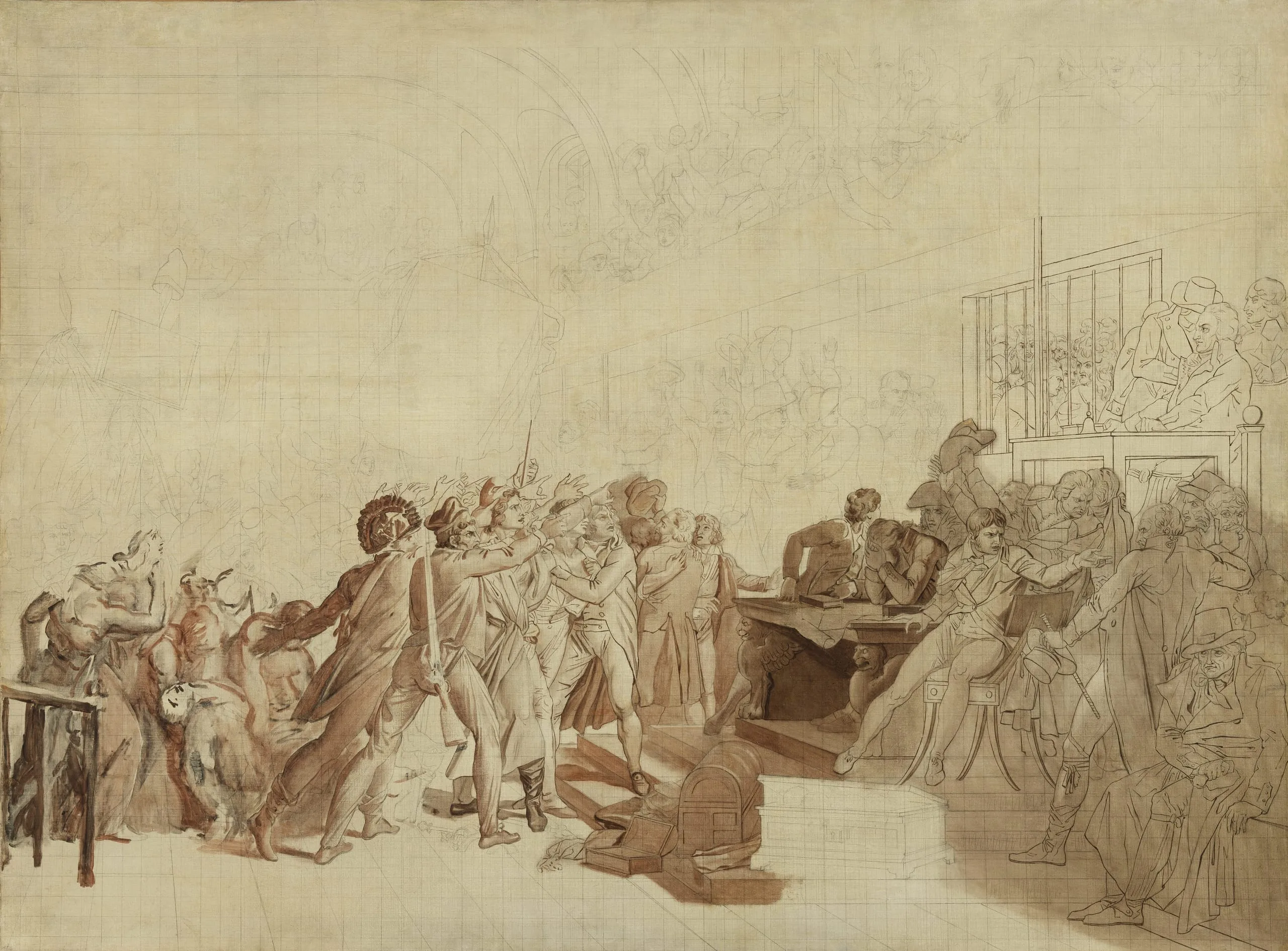
- The 10th of August, 1792
- Date Made
- circa 1795-1799
- Medium
- Oil with graphite on canvas
- Dimensions
- Canvas: 42 × 56 3/4 in. (106.68 × 144.15 cm)
Framed: 56 1/2 × 71 × 4 in. (143.51 × 180.34 × 10.16 cm)
- Accession Number
- M.2000.179.36
- Curatorial Notes
Painter Baron François-Pascal-Simon Gerard used his connection as Jacques-Louis David's understudy to evade conscription in 1793 and avoid proclaiming political allegiances. During a tumultuous period in France, he spent his career aligning himself with the parties in power, serving as the official portrait painter for Napoleon and then working for the reinstated Bourbon monarchs.
Here, Gerard sketched a microcosmic drama depicting the people’s triumph on the 10th of August, a key event in the French Revolution: the people stand powerful, armed with their pointed fingers and aggressive postures, while the king and queen lurk helplessly behind bars. The composition of the work adds to this drama by relegating the royal duo to the background. In a similar spirit, the works of the playwright Pierre-Augustin Caron de Beaumarchais (1732-1799), which gave rise to the fictional character of Figaro, openly criticized aristocratic authority in the years before the Revolution. In works by Beaumarchais, Figaro uses his cunning to quietly manipulate the Count Almaviva, taking a more covert approach than Gerard’s bourgeoisie, who employ vehement disapproval and violence to overthrow Louis XVI and Marie Antoinette.
- Provenance
Family of the artist, by descent to; Gramont. Andrew S. Ciechanowiecki (1924–2015), London, by 1973, sold 2000 to; LACMA.
- Selected Bibliography
- Marandel, J. Patrice. French oil sketches from the Los Angeles County Museum of Art, 17th century - 19th century. Los Angeles: The Ahmanson Foundation, Los Angeles County Museum of Art, 2002.
- Moulin, Monique. "François Gérard, Peinture du 10 Août 1792." Gazette des Beaux-Arts 101 (May-June 1983):
- Los Angeles County Museum of Art. New York: Thames and Hudson, 2003.
- Marandel, J. Patrice. French Oil Sketches from an English Collection, Seventeenth, Eighteenth, and Nineteenth Centuries 1973-1975. Houston, TX: The Museum of Fine Arts, 1975.
- Bordes, Philippe, Le serment de Jeu de Paume de Jaques-Louis David. Paris: Editions de la Reunion des Musées Nationaux, 1983
- Olander, William. "Pour transmettre à la postérité, French Painting and Revolution, 1774-1795." Ph.D. dissertation, New York University, Institute of Fine Arts, 1983.
- Wintermute, Alan. ed., 1789: French art during the Revolution. New York : Colnaghi, 1989.
- Walch, Peter, , Joanna R. Barnes, J. Patrice Marandel. French Oil Sketches and the Academic Tradition. New York : American Federation of Arts in association with the University of Pennsylvania Press, 1994.
- Schnapper, Antoine, et al. Jacques-Louis David (1748-1825) (exh. cat.). Paris: Musée du Louvre and Musée National du Château de Versailles, 1989
- Lehmbeck, Leah, editor. Gifts of European Art from The Ahmanson Foundation. Vol. 2, French Painting and Sculpture. Los Angeles: Los Angeles County Museum of Art, 2019.