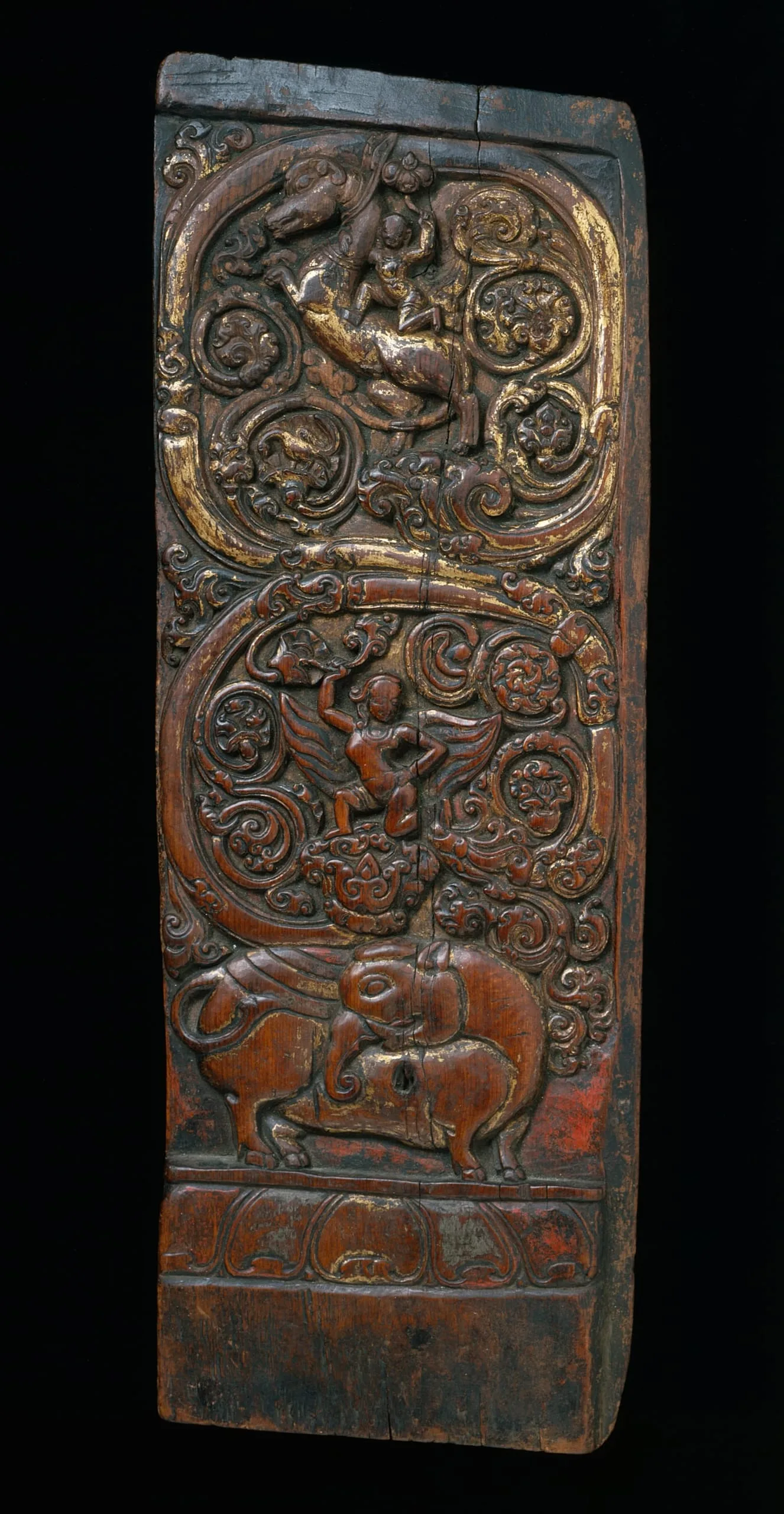
Dating most likely from the 14th century, this lyrically designed panel with gilding and traces of paint is a tour de force of early Tibetan woodcarving. It was originally the proper right-side wing of an elaborate throneback behind an image of a Buddhist deity or revered teacher. The iconographic ordering of its parts follows the traditional imagery of South Asian and Himalayan thronebacks, now known primarily only from painted representations. The base is composed of lotus petals, upon which an elephant majestically stands. In this case, the elephant is portrayed with stylized proportions derived from neighboring Chinese artistic traditions. Above the elephant are exuberant foliate medallions encircled in vines with floral terminals, which are derived from the contemporary Densatil school of Tibetan art. In the center of the lower medallion is a winged demigod (kinnara) representing celestial riches. In the upper medallion is a rearing horned leonine creature (vyala or shardula) with a rider, again symbolic of heavenly wealth, as well as the holder of the throne's mastery over the natural and supernatural worlds.
Most of the extant examples of early Tibetan woodcarving in Western museum collections are either manuscript covers (see M.86.345.12 and M.78.101.1) or, to a lesser extent, images of deities and nobility (see M.75.67 and AC1993.147.1). This exceptional throneback provides rare evidence for the actual physical form and media of an ornate early Tibetan throne. See also M.74.10.2a and .2b, and M.81.90.5.