- Title
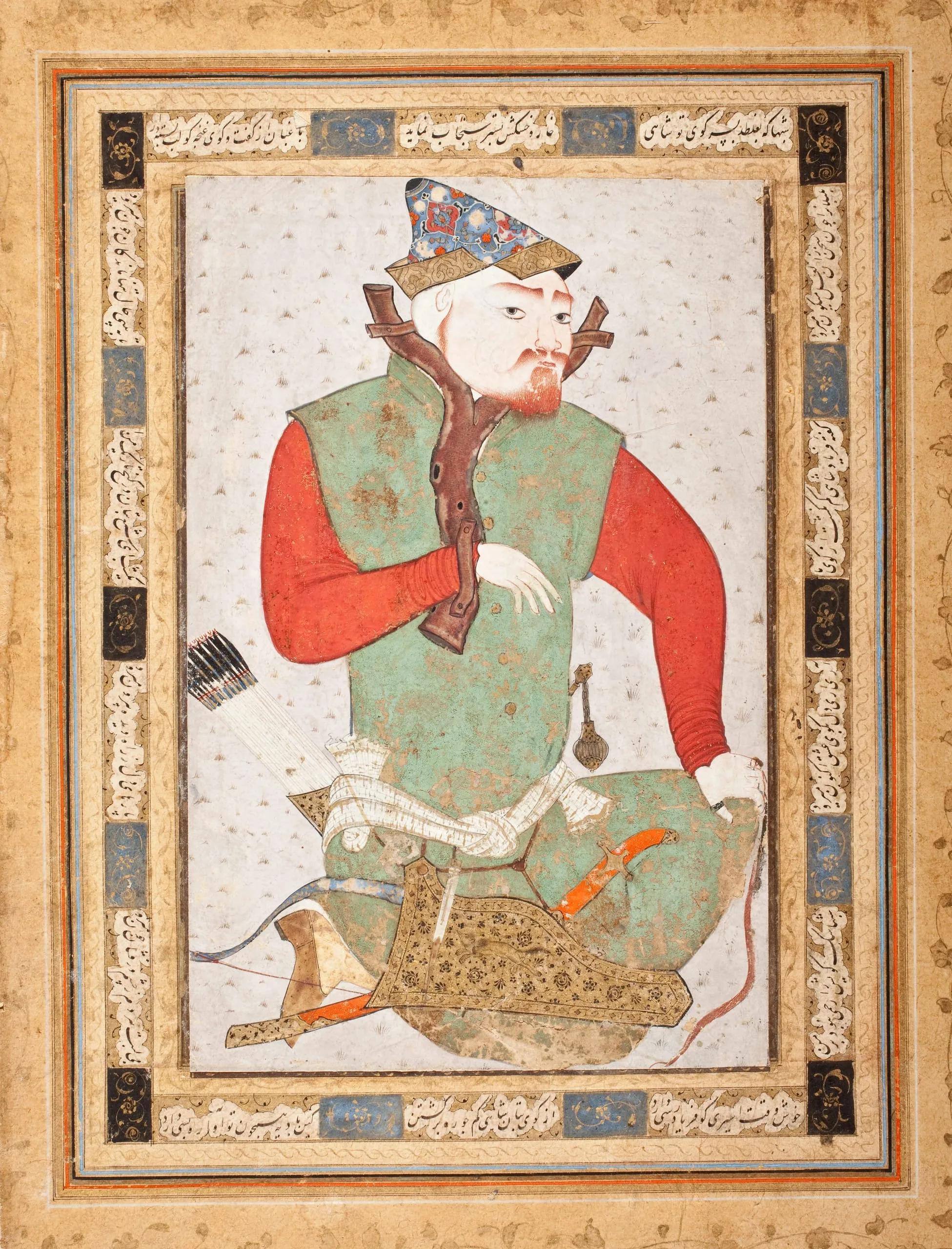
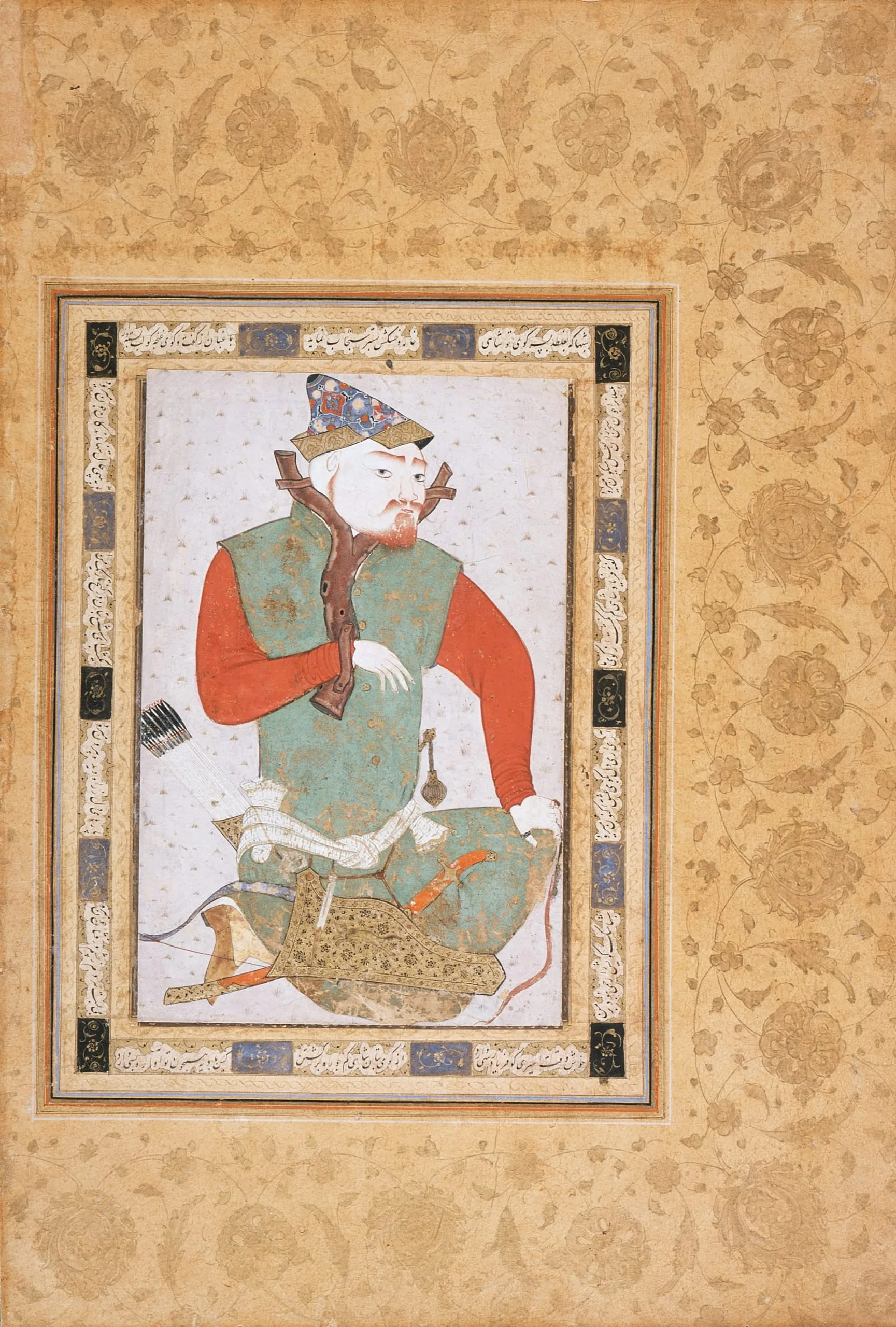
- Turkoman Prisoner
- Date Made
- second half of 16th century
- Medium
- Ink, opaque, watercolor, and gold on paper
- Dimensions
- Image: 8 7/16 × 5 1/2 in. (21.5 × 14 cm)
Sheet: 17 1/2 × 11 13/16 in. (44.5 × 30 cm)
Frame: 23 × 19 × 1 1/2 in. (58.42 × 48.26 × 3.81 cm)
- Accession Number
- M.2000.135
- Curatorial Notes
The Turkoman prisoner is a common subject in Iranian art (also see M.85.237.28). The motif was copied and subtly interpreted in both drawings and paintings, which were probably intended for placement in albums. The prisoner depicted here, as in all such representations, is fettered by a palahang, a device made from a forked branch, to which one wrist is attached by an additional band of wood or metal. A crossbar at the back of the prisoner’s neck completes the restraint. Based on the Persian poetry that surrounds the painting, it is possible to suggest a less literal meaning for this imagery. The verses give voice to the torments of unrequited love, a common theme in classical Persian poetry. Claiming to haunt the street of the beloved by night, the lover moans, "Happy is that prisoner who has someone to come to his rescue."
- Selected Bibliography
- Komaroff, Linda. "A Turkman Prisoner or Prisoner of Love?" In No Tapping around Philology: a Festschrift in Honor of Wheeler McIntosh Thackston Jr.'s 70th Birthday, edited by Alireza Korangy and Daniel J. Sheffield, 369-80. Wiesbaden: Otto Harrassowitz, 2014.
- Komaroff, Linda. Collecting Islamic Art at the Los Angeles County Museum of Art: A Curatorial Perspective. Los Angeles: Art Catalogues; LACMA, 2017.
- Rizvi, Kishwar. "Between the Human and the Divine: The Majālis al-ushshāq and the Materiality of Love in Early Safavid Art." In Ut Pictura Amor: The Reflexive Imagery of Love in Artistic Theory and Practice, 1500-1700, edited by Walter Melion, Michael Zell, and Joanna Woodall, 230-63. Leiden: Koninklijke Brill NV, 2017.
Komaroff, Linda. "Islamic Art Now and Then." In Islamic Art: Past, Present, Future, edited by Sheila Blair and Jonathan Bloom, 26-56. New Haven, New York, and London: Yale University Press, 2019.
- Çakır Phillip, Filiz. "The Battle Flail - A Differentiating Feature of the Turk." In 16th International Congress of Turkish Art. October 3-5, 2019. Ankara: Proceedings, vol. 1, 377-91. Istanbul: TC Kültür ve Turizm Bakanlığı, 2023.