- Title
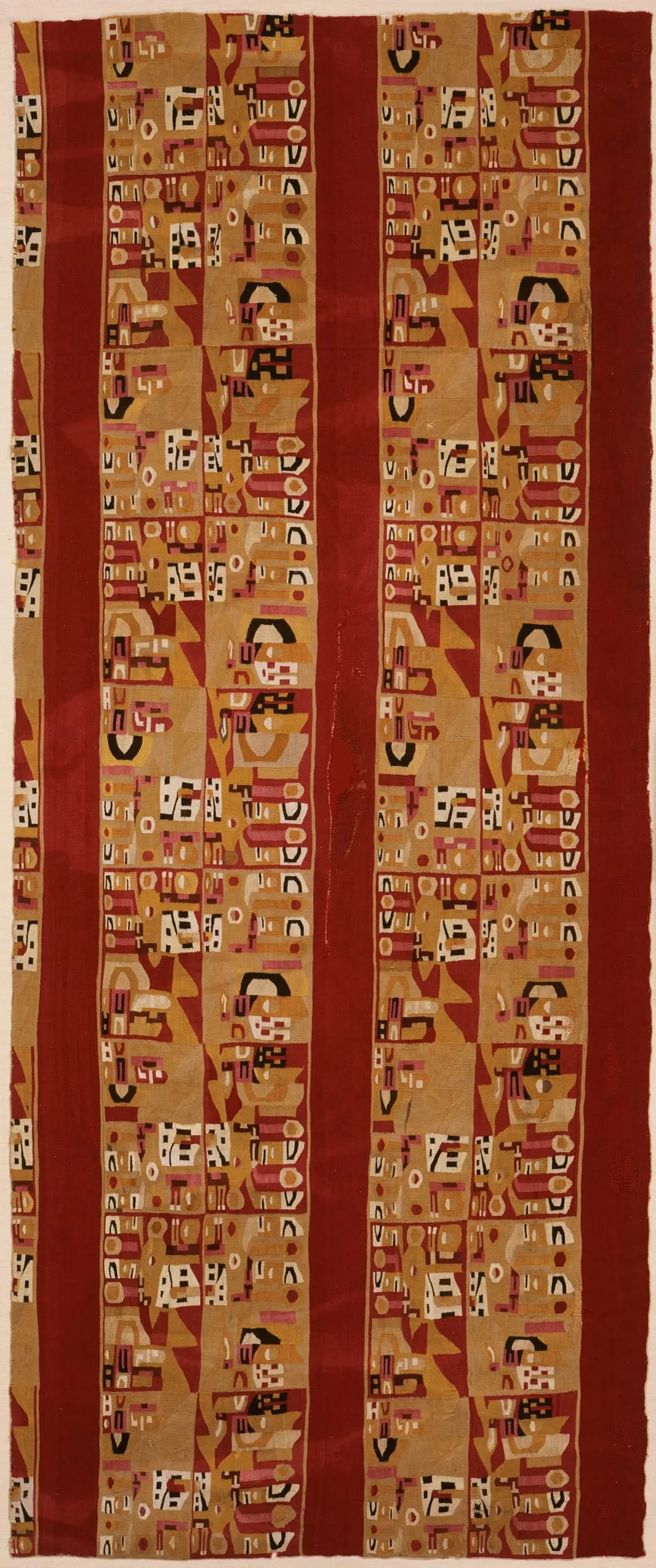
- Fragment of a Man's Tunic
- Date Made
- 600-850
- Medium
- Camelid fiber and cotton interlocked tapestry
- Dimensions
- 50 x 21 in. (127 x 53.34 cm)
- Accession Number
- M.80.71.1
- Curatorial Notes
This fragment of a tunic is a remarkable example of how Wari artists used elaboration and distortion of form to create iconic images that waver between legible and illegible. The format is rigid; the pattern is developed in an enclosed rectangular field, and the composition features reflective symmetry—the upright figure is mirrored upside-down and faces a variation of itself.
The running, staff-bearing, winged attendant figure in profile is the most prevalent symbol in Wari iconography. Here it is depicted without a staff as a human-feline with a large muzzle and fangs, which act as a focal point while the viewer simultaneously deciphers the highly abstracted body parts and costume elements. In addition to reconstructing form, Wari artists confounded legibility through a sophisticated use of color that nearly obliterates the relationship between figure and ground. The difficulty in creating such a design may be gauged by the fact that the artists had to keep each aspect of this complex composition in mind—while weaving the entire pattern sideways. This tunic would have been an extremely valuable item, made for a very elite patron. The deep, red color seems to have been a trademark of the Wari empire, as it appears frequently on elite painted Wari ceramics.
Nicole LaBouff via Kaye Spilker
2009