- Title
- Pair of Clappers
- Date Made
- New Kingdom (1550–1070 BCE)
- Medium
- Wood
- Dimensions
- each: 9 13/16 × 1 1/16 × 1/4 in. (24.92 × 2.7 × 0.64 cm)
- Accession Number
- M.80.202.165a-b
- Curatorial Notes
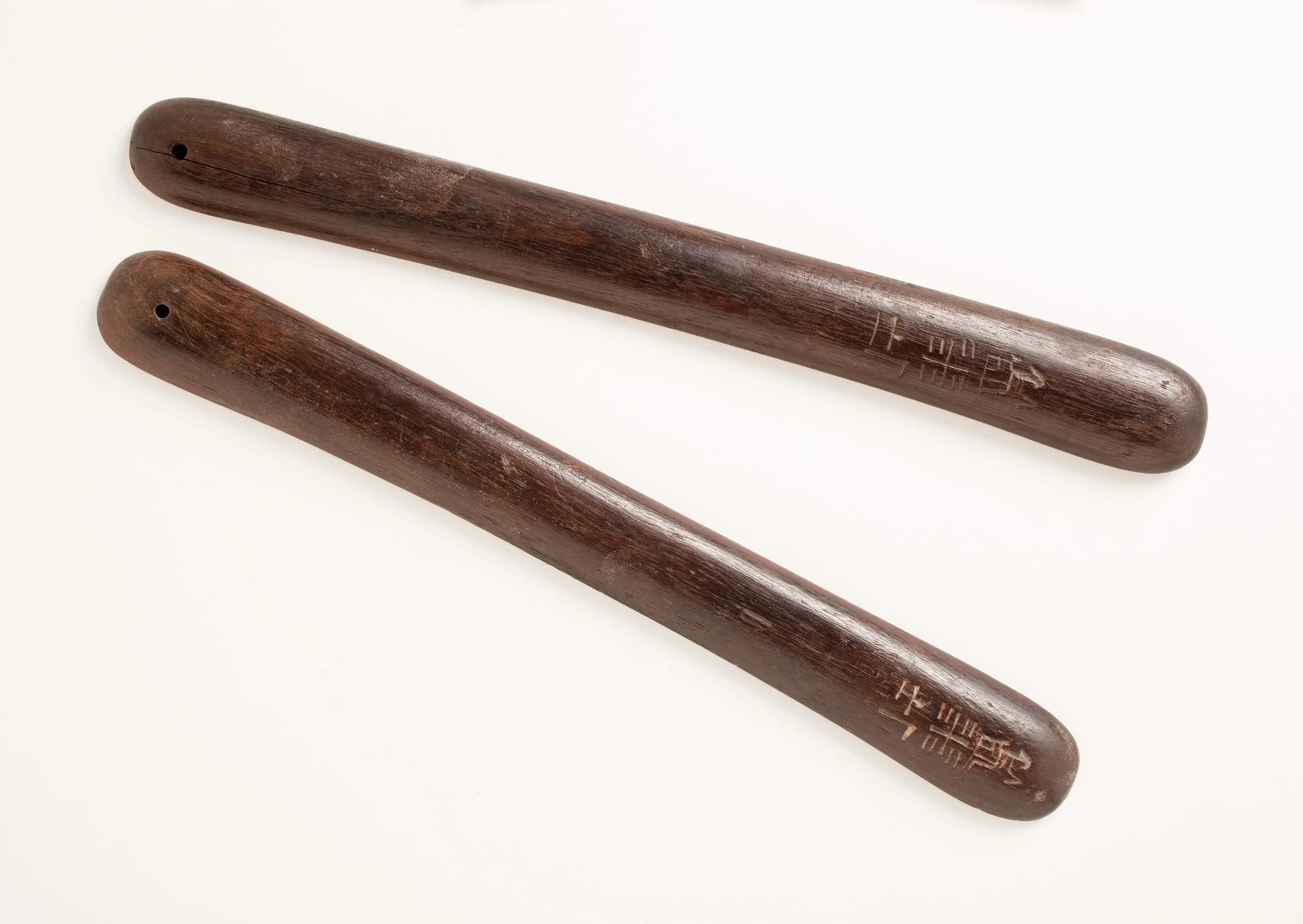
Ancient Egyptians produced a variety of percussion instruments. Clappers would have accompanied secular dance performances and sacred rituals. Ivory clappers sometimes took the form of human arms, complete with hands and decorative bracelets. This example is more straightforward, with simple markings. Each slightly concave clapper is pierced with holes at the base, through which a cord would have been passed to secure the instrument to the player’s wrist. Each is inscribed: “A god’s offering for Shepsi who is in Hermopolis” (Tp-ntr n psi imy mnw). The solar god Shepsi, who first appears in the 18th Dynasty, was regarded as the father of the eight deities associated with Hermopolis, an important city in Middle Egypt. He was often equated with the dominant god of Thebes, Amun-Re. The inscription and the lack of wear suggest that these clappers functioned solely as votive offerings to Shepsi. Many ancient Egyptian wood items were remarkably well preserved due to the extremely dry and stable conditions of undisturbed burials.