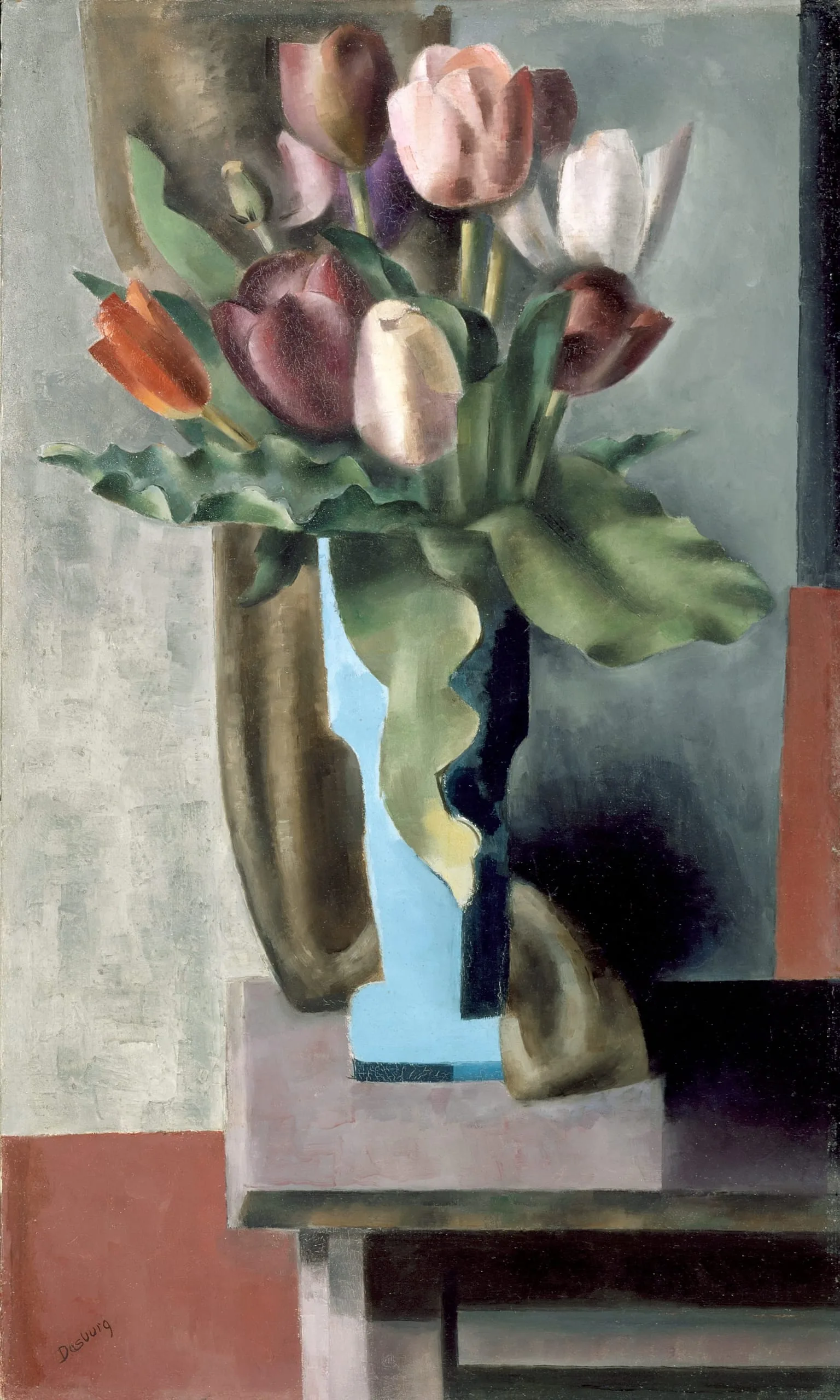
Still-life paintings were important to Dasburg from the time he copied a Cézanne painting of apples owned by Leo Stein in Paris. During the 1920s he painted quite a few floral and fruit still lifes, using them as a vehicle for his analytical explorations of formal elements. As did Cézanne, he usually set his still-life objects before a plain background on a simple, wood table that appears tilted. The upward movement of the tulip’s shape fascinated him, and he depicted the flower in a number of paintings. Tulips is one of the sparest and most vertical of Dasburg’s still lifes, and its verticality may have been determined by the flower, which Dasburg placed almost in the center of the composition. The curved petals and the curves and ripples of the leaves establish a sense of movement and form both the dominant horizontal and vertical elements of the composition.
Since its showing in the First Pan-American Exhibition of Oil Paintings in the winter of 1925-26 the painting has been given a date of 1923. In an inventory compiled years later, Dasburg, somewhat hesitantly, dated it 1924. Either date could be correct, since Dasburg demonstrated his strongest interest in cubism at this time. He even published an article on cubism (Arts 4 November 1923]: 278-84). Tulips is a classic example of Dasburg’s interpretation of the aesthetic, for he defined cubism as "a kind of architectonic paraphrase of a motif" In his geometric shapes, flattening of objects and space, and jigsaw puzzle composition, Dasburg clearly acknowledged his debt to synthetic cubism.
Dasburg did not wholly adopt that aesthetic. He always retained more of the threedimensional form than did the Frenchhere in the softly modeled flowers. Moreover, he rejected the flatness, airlessness, and highkeyed palette of synthetic cubism. In Tulips Dasburg limited the intensity of the hues (muted purple, pink, orange, green, and gray) while giving them a rich subtlety by the use of passages of translucent paint. By applying the pigment in short, square strokes he increased the liveliness of the surface, so instead of being static, this highly geometric painting seems to shimmer and pulsate with life.