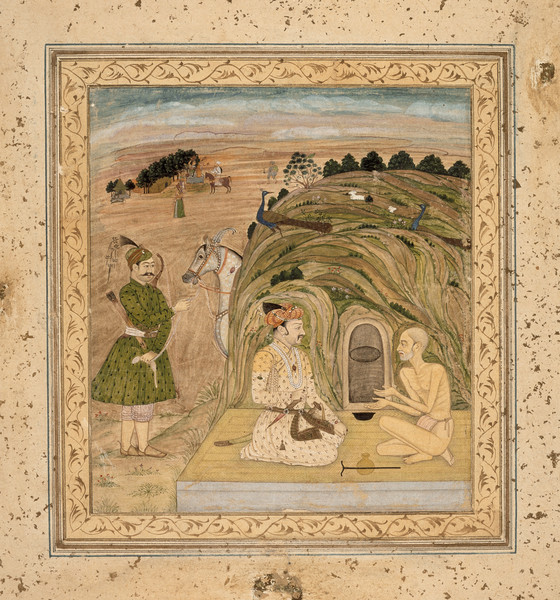
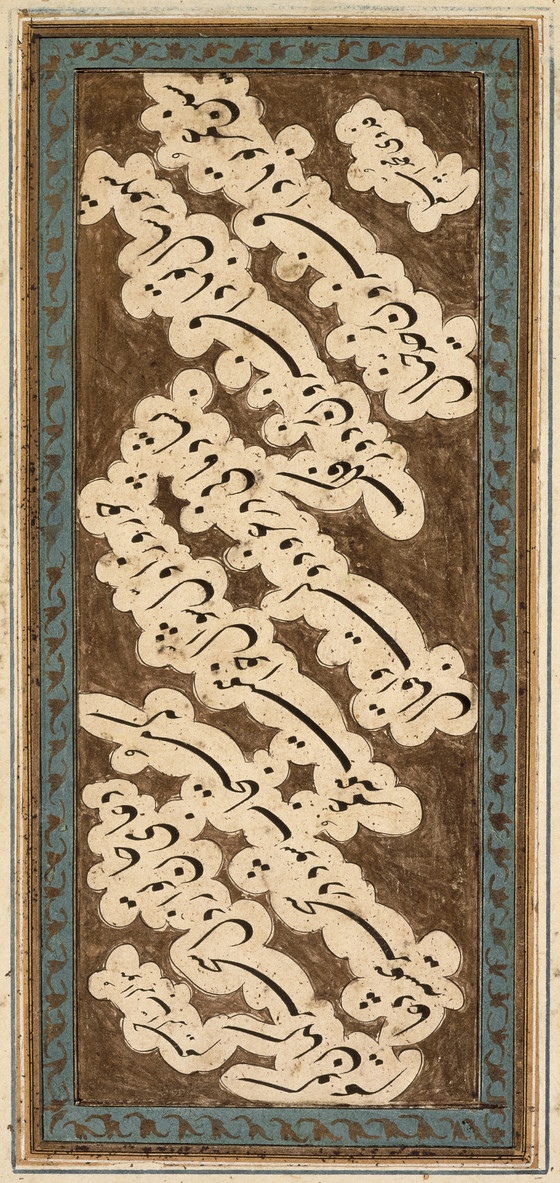
Emperor Jahangir (r. 1605-1627) Visiting the Ascetic Jadrup (recto), Calligraphy (verso)
* Nearly 20,000 images of artworks the museum believes to be in the public domain are available to download on this site. Other images may be protected by copyright and other intellectual property rights. By using any of these images you agree to LACMA's Terms of Use.

Emperor Jahangir (r. 1605-1627) Visiting the Ascetic Jadrup (recto), Calligraphy (verso)

India, Rajasthan, Bikaner or Kishangarh, Mughal, circa 1750-1775
Drawings; watercolors
Opaque watercolor, gold, and ink on paper
Sheet: 11 1/4 x 10 1/2 in. (28.58 x 26.67 cm); Image: 6 5/8 x 5 7/8 in. (16.83 x 14.92 cm)
Purchased with funds provided by Lizabeth Scott (M.87.20.2)
Not currently on public view

Curator Notes

In the 18th and 19th centuries it was a common practice to make copies of great paintings from the golden era of the Mughals in the 17th century....
In the 18th and 19th centuries it was a common practice to make copies of great paintings from the golden era of the Mughals in the 17th century. This folio is a partial copy of one of the dispersed illustrations from the Jahangirnama (Memoirs of Jahangir) that is now in the Musée Guimet, Paris (7171). The original painting, attributed to circa 1616-1620 by the master artist Govardhan (active circa 1596-1645), shows a vignette similar in composition to the LACMA work in its top half, while the bottom half has a crowded scene of the retinue of Emperor Jahangir (r. 1605-1627). The horse and groom in the original’s bottom half have been updated stylistically and incorporated in the copy’s top half behind Jahangir, and the distant cityscape in the original has been transformed to a distant village scene with an ascetic’s hermitage and a rider being given water from a well. The depictions of Jahangir and the ascetic Jadrup in the two works are clearly a model-and-copy, with only minor variations in detail and style. Jadrup was a respected Hindu religious hermit who lived in a cave outside of Ujjain, Madhya Pradesh, and later moved to near Mathura, Uttar Pradesh. He was sixty years of age when first visited by Jahangir in 1617 and had previously been consulted by Jahangir’s father, Emperor Akbar (r. 1556-1605). In his memoirs Jahangir relates his awe of Jadrup’s cave dwelling, austere existence, and spiritual knowledge.
More...

Bibliography

  • Los Angeles County Museum of Art Members' Calendar 1988,  vol. 25-26, no. 12-1 (December, 1987-January, 1989).
  • Schmitz, Barbara, ed.  After the Great Mughals:  Painting in Delhi and the Regional Courts in the 18th and 19th Centuries.  Mumbai, India:  Marg Publications, 2002.