

Curator Notes
Ornate ivory combs were among the earliest grooming accessories and ornaments for personal display made in South Asia. They were also among the earliest known South Asian export items, as documented by a Harappan ivory comb attributed to 2400 BCE, now in the Salut Museum, Oman (2009:30). Discovered in the ancient harbor and trade entrepôt, Ras al-Jinz, in the easternmost coast of Oman, it was presumably imported from the Indus Valley Civilization as a luxury item.
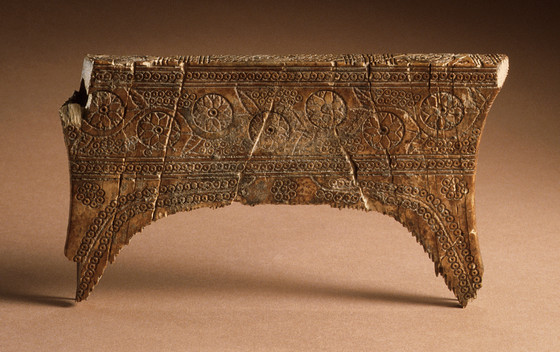
Attributed to the 1st century, this ivory comb is likely from the Taxila region of ancient Gandhara (parts of present-day Pakistan and Afghanistan), which was a major nexus of the Silk Routes connecting Rome and China. It represents the continuation of the early South Asia tradition of producing ornate ivory combs. Its comparatively large size also suggests it was a costly luxury item.
The comb is rectangular with concave sides. The teeth of this originally fine-toothed comb are now lost, probably due to breakage. The handle is ornamented with an incised horizontal panel with a coin border. It is filled with burgeoning lotus blossoms on scrolling vines that symbolize Buddhist concepts of purity, enlightenment, and paradise. Assimilated from Greco-Roman artistic conventions, scrolling vines with lotuses were often incorporated into Gandharan architecture as a design element, such as on a frieze in the Metropolitan Museum of Art, New York (13.96.24). On the curved sides flanges, willowy fronds with seed clusters and medallions gracefully encircle the mouth of the comb.
The long cultural continuity of the LACMA comb’s design form and decoration is exemplified by a wooden comb, attributed to the 16th–17th century, in the Metropolitan Museum of Art, New York (21.114.9).
See also M.80.232.1, M.83.218.1, M.83.218.5, and M.87.275.2.
More...