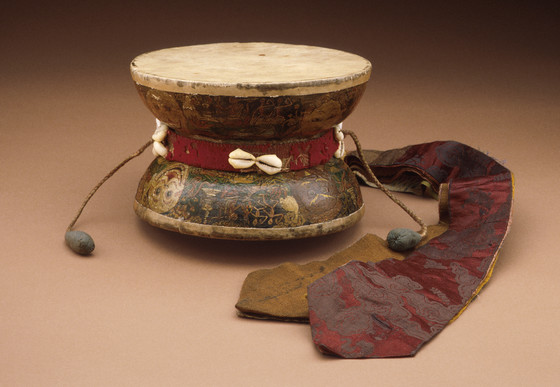
Ritual Pellet Drum

* Nearly 20,000 images of artworks the museum believes to be in the public domain are available to download on this site. Other images may be protected by copyright and other intellectual property rights. By using any of these images you agree to LACMA's Terms of Use.

Ritual Pellet Drum

Tibet, circa 18th century
Tools and Equipment; musical instruments
Opaque watercolor on wood with animal skin and cowry shells; cotton and brocade silk fittings
5 x 7 1/4 x 7 1/4 in. (12.7 x 18.42 x 18.42 cm)
Purchased with funds provided by Harry and Yvonne Lenart (M.86.127)
Not currently on public view

Curator Notes

...
Pellet drums (damaru) are hourglass in shape with two opposite-facing drums and two striking pellets connected to the drum by a cord. The drums are often made from two human craniums connected at the point of the crown with a hole drilled to connect the two chambers of the drum, or from hemispherical wooden drums similarly joined together. The skulls are gathered from the charnel fields or reportedly bequeathed by the Buddhist monks themselves. They are never taken from living persons killed for the purpose of obtaining their skull. The drumheads or drum skins are made of stretched and sometimes painted animal hide, usually from goats, cows, or calves. Pellet drums in Tibet, Mongolia, and India are played by grasping it by its waist. When the hand is rotated back and forth, the pellets strike the drumheads to produce various rhythms. Tibetan pellet drums are often used in Tantric rituals and esoteric rites of exorcism. See Huntington and Bangdel, 2003, pp. 364-365, nos. 106A and 106B. This pellet drum is made of two joined wooden drums with unadorned skin drumheads. The exterior of the drum is embellished with painted scenes of the eight cremation grounds featuring grinning skulls or fierce faces at the four opposite points. Between them are various dancing skeletons (chitipati; see M.91.203), Tibetan stupas (chöten; see M.76.130, M.82.200.3, M.87.53.1, AC1992.58.1a-b), ascetics playing thighbone trumpets (kangling; see M.81.90.19), and jackals and other scavengers. A necktie-shaped cotton and brocade silk banner is connected to the waist of the drum by a cotton band adorned with cowrie shells. See also M.85.298.2 and AC1998.34.1.
More...

Bibliography

  • Pal, Pratapaditya. Art of Tibet. Expanded edition. Los Angeles: Los Angeles County Museum of Art, 1990.
  • Huntington, John C. and Dina Bangdel.  The Circle of Bliss:  Buddhist Meditational Art.  Columbus:  The Columbus Museum of Art; Chicago:  Serindia Publications, 2003.