...
Pellet drums (damaru) are hourglass in shape with two opposite-facing drums and two striking pellets connected to the drum by a cord. The drums are often made from two human craniums connected at the point of the crown with a hole drilled to connect the two chambers of the drum, or from hemispherical wooden drums similarly joined together. The skulls are gathered from the charnel fields or reportedly bequeathed by the Buddhist monks themselves. They are never taken from living persons killed for the purpose of obtaining their skull. The drumheads or drum skins are made of stretched and sometimes painted animal hide, usually from goats, cows, or calves. Pellet drums in Tibet, Mongolia, and India are played by grasping it by its waist. When the hand is rotated back and forth, the pellets strike the drumheads to produce various rhythms. Tibetan pellet drums are often used in Tantric rituals and esoteric rites of exorcism. See John C. Huntington and Dina Bangdel, The Circle of Bliss: Buddhist Meditational Art (Columbus: Columbus Museum of Art and Chicago: Serindia Publications, 2003), pp. 364-365, nos. 106A and 106B.
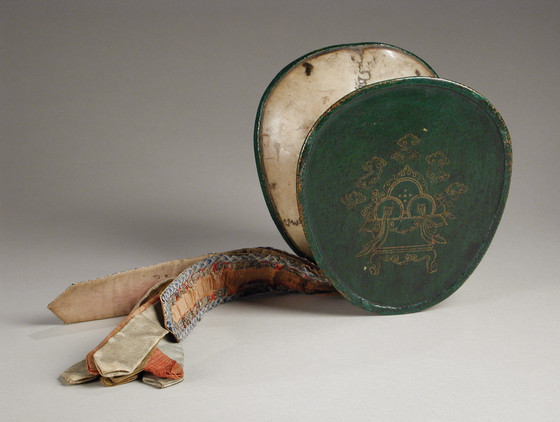
This pellet drum is made of two joined human skulls with painted animal head drumheads. One drum skin is painted in gold outline with a blood-filled skull cup (kapala) with body parts emerging from the blood (see M.79.243.4a-b and M.82.201a-c). The opposite drumhead features a cloth-covered altar stand with the five sense offerings and their symbols. In the center is sight represented by a flaming mirror (darpana; see M.87.211). It is flanked by two cymbals symbolizing sound. On the far left is a conch shell containing perfumed water that signifies smell. On the far right are peaches on leafed sprigs emblematic of taste. The cloud-collar cloth embodies touch. Five clouds float above the altar. See Robert Beer, The Encyclopedia of Tibetan Symbols and Motifs (Boston: Shambala Publications, 1999), pp. 194-204, pls. 92-95. See also M.86.127 and AC1998.34.1.
More...