Raja Raj Singh of Guler (r. 1685-1695)
* Nearly 20,000 images of artworks the museum believes to be in the public domain are available to download on this site. Other images may be protected by copyright and other intellectual property rights. By using any of these images you agree to LACMA's Terms of Use.

Raja Raj Singh of Guler (r. 1685-1695)

India, Himachal Pradesh, Guler, circa 1690-circa 1710
Drawings; watercolors
Opaque watercolor and gold on paper
Image: 7 3/8 x 5 1/2 in. (18.73 x 13.97 cm); Sheet: 9 1/2 x 7 3/8 in. (24.13 x 18.73 cm)
Gift of Mr. and Mrs. Michael Douglas (M.85.283.9)
Not currently on public view

Curator Notes

Raja Raj Singh of Guler (r. 1685-1695) was the twenty-first ruler of Guler in present-day Himachal Pradesh. His father, Raja Bikram Singh (r....
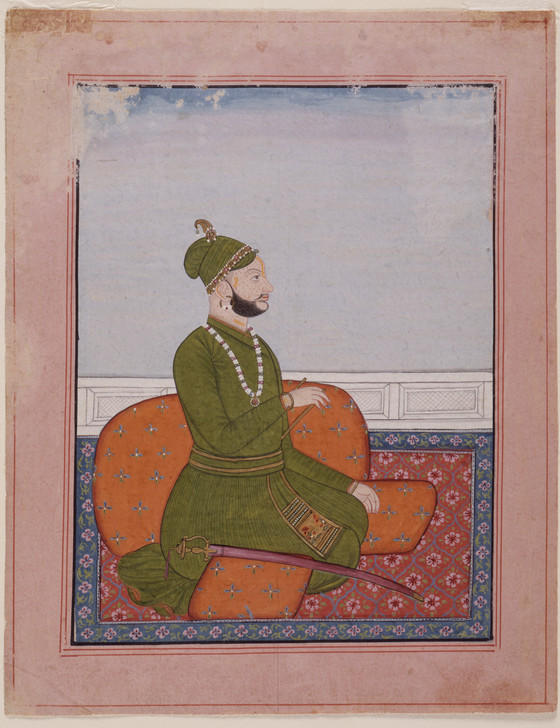
Raja Raj Singh of Guler (r. 1685-1695) was the twenty-first ruler of Guler in present-day Himachal Pradesh. His father, Raja Bikram Singh (r. 1661-1685), had fought for the Mughal Emperor Aurangzeb (r. 1658-1707) on the North-West Frontier (present-day Khyber Pakhtunkhwa). Raj Singh, however, abandoned military campaigning for the Mughals. At the time of his accession the Mughal governor of Lahore had been making incursions into the hill states. In order to recover lost Rajput territory, Raj Singh formed a successful alliance with Raja Chattar Singh of Chamba (r. 1664-1690), Raja Dhiraj Pal of Basohli (r. 1693-circa 1773), and Raja Kirpal Dev of Jammu [Bahu branch] (r. circa 1660-1690). He also aided the Mandi and Bilaspur kingdoms in their struggles against similar threats. In this painting, Raj Singh is seated leaning against a bolster on a carpet on a palace terrace. He wears a green turban with a jigha (plume-like ornament similar to an aigrette) and a bejeweled band functioning as an extended sarpati ornament. He has a pearl-and ruby hoop earring and a pearl-emerald-and-ruby necklace with a gold and pendant. His pockmarked face has sectarian markings. He wears a matching green coat (jama) and a waist sash with floral embroidery on a gold ground (patka). He has a punch dagger (katar) tucked into the far side of his waist sash and a sheathed sword beside him. A comparable but unfinished portrait of Raj Singh is in the Museum of Fine Arts, Boston (17.2727).
More...