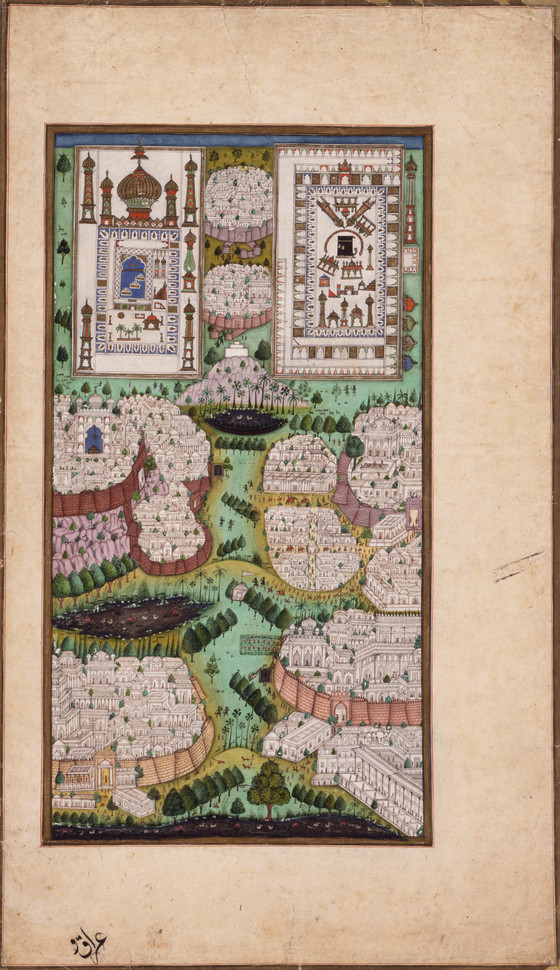
The Pilgrimage Cities of Arabia (verso), Text (recto), Folio from a Gulshan-i 'Ishq (Flower Garden of Love)
* Nearly 20,000 images of artworks the museum believes to be in the public domain are available to download on this site. Other images may be protected by copyright and other intellectual property rights. By using any of these images you agree to LACMA's Terms of Use.

The Pilgrimage Cities of Arabia (verso), Text (recto), Folio from a Gulshan-i 'Ishq (Flower Garden of Love)

India, Telangana, Hyderabad, circa 1710
Drawings; watercolors
Opaque watercolor, gold, and ink on paper
Image (Image): 10 5/8 x 5 5/8 in. (26.9875 x 14.2875 cm) Sheet (Sheet): 14 7/8 x 8 5/8 in. (37.7825 x 21.9075 cm) Frame: 23 1/2 × 19 1/2 × 1 1/4 in. (59.69 × 49.53 × 3.18 cm)
The Edwin Binney, 3rd, Collection of Turkish Art at the Los Angeles County Museum of Art (M.85.237.74)
Not currently on public view

Curator Notes

The Gulshan-i 'Ishq (Flower Garden of Love) was written in Deccani Urdu in 1657 by Mullah Nusrati (birthname: Muhammad Nusrati, d. 1674). He was a court poet of Sultan Ali Adil Shah II of Bijapur (r....
The Gulshan-i 'Ishq (Flower Garden of Love) was written in Deccani Urdu in 1657 by Mullah Nusrati (birthname: Muhammad Nusrati, d. 1674). He was a court poet of Sultan Ali Adil Shah II of Bijapur (r. 1656-1672). The Gulshan-i 'Ishq is one of several renditions of an ancient tale of the forbidden young lovers, Prince Manohar and Madhumalati. The original version is an 8th-century Sanskrit drama by Bhavabhuti. Later narrations of the tale include renderings by the Rajasthani poet Chaturbhujdas in circa 1500 (see M.86.345.9) and a Sufi poem composed in 1545 by Mir Sayyid Manjhan Rajgiri. This folio is from a dispersed Gulshan-i 'Ishq attributed to Hyderabad, circa 1710. Another folio from this manuscript is in the Metropolitan Museum of Art, New York (2011.183). Additional manuscripts of the Gulshan-i 'Ishq are in Philadelphia Museum of Art and the Salar Jung Museum, Hyderabad. Verso: The pilgrimage cities of Arabia are depicted in an aerial perspective map that provides a panoramic bird’s-eye view of the Kaaba in the Masjid al-Haram (Inviolable Mosque) at Mecca (upper right), the Al-Masjid an-Nabawi (Prophet's Mosque) at Medina (upper left), and other architectural complexes. The Kaaba and the Prophet’s Mosque are rendered in formulaic depictions based on Turkish sources. The remaining sites are portrayed following the visual traditions of Hindu and Jain pilgrimage maps, such as the myriad vistas of Shatrunjaya Hill in Palitana, Gujarat. Recto: Calligraphy in nastaliq script.
More...

Bibliography

  • Denny, Walter B.  Turkish Treasures from the Collection of Edward Binney, 3rd.  Portland, OR:  Portland Art Museum, 1979.