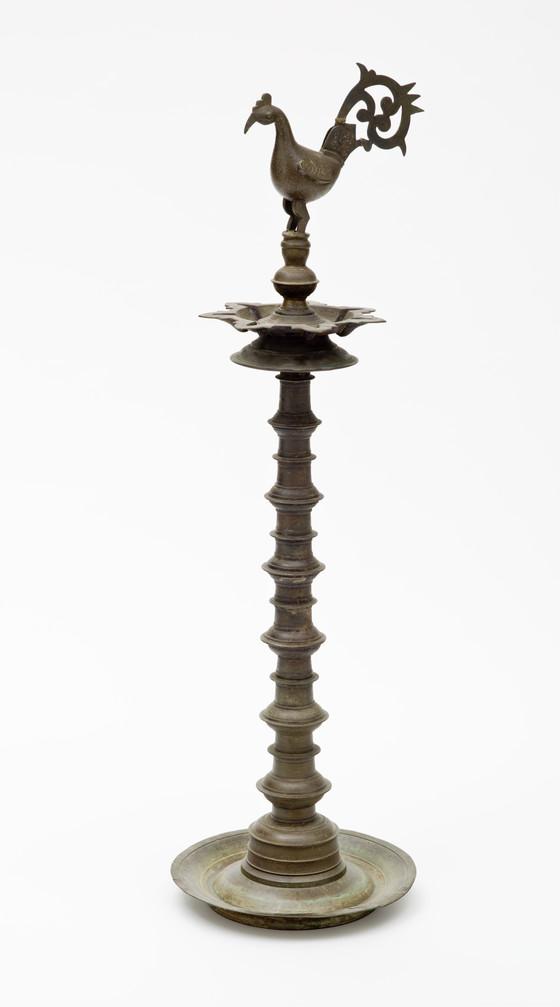
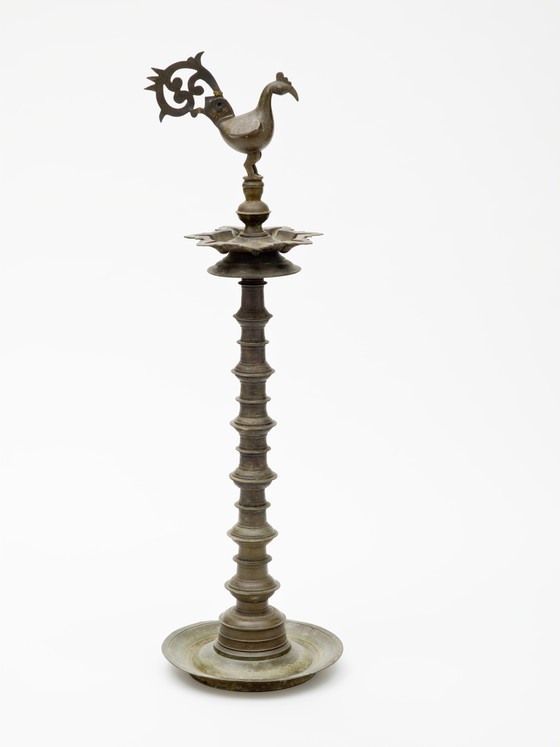
Oil Lamp (samai) with a Rooster Finial
* Nearly 20,000 images of artworks the museum believes to be in the public domain are available to download on this site. Other images may be protected by copyright and other intellectual property rights. By using any of these images you agree to LACMA's Terms of Use.

Oil Lamp (samai) with a Rooster Finial

India, Deccan, 19th century
Furnishings; Lighting
Copper alloy
47 x 14 in. (119.38 x 35.56 cm)
Gift of Mr. and Mrs. Michael Phillips (M.84.227.8)
Not currently on public view

Curator Notes

...
This columnar lamp has a shaft resembling a spindle column of lathe-turned wood with compressed ball and ring moldings. It tapers in diameter from the base in the form of a saucer-shaped drip tray to the fuel receptacle shaped like a shallow footed tray with six spouts that also serve as wick holders. The rooster finial is identified anatomically by the presence of the fleshy growth on top of his head called a comb or cockscomb, and by the long curved tail feathers cascading downward, called sickle feathers. It has small wings with chased feathers. The neck and chest have a chased scallop-shell pattern of feathers and four necklaces. The legs are abstractly rendered and have miniscule clawed toes. Oil lamps from South and Southeast Asia and the Himalayas have been fashioned in a wide variety of conceptual forms, including anthropomorphic, zoomorphic, phytomorphic, abstract, and combined creations. Burning lamps have long been used in places of worship and for domestic rituals by adherents of all the major religions throughout the diverse regions. They help demarcate and purify a sacred space, and can symbolize a practitioner’s enlightenment. See also AC1993.152.1 and AC1995.152.1.
More...

Bibliography

  • El Universo de la India: Obras Maestras del Museo de Arte del Condado de Los Angeles. Santiago: Centro Cultural Palacio La Moneda, 2012.