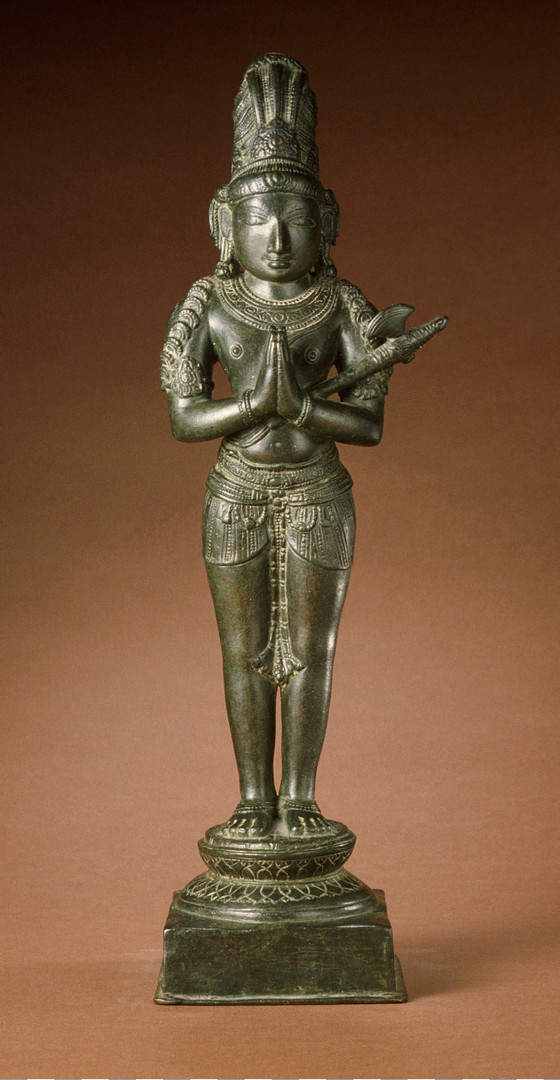
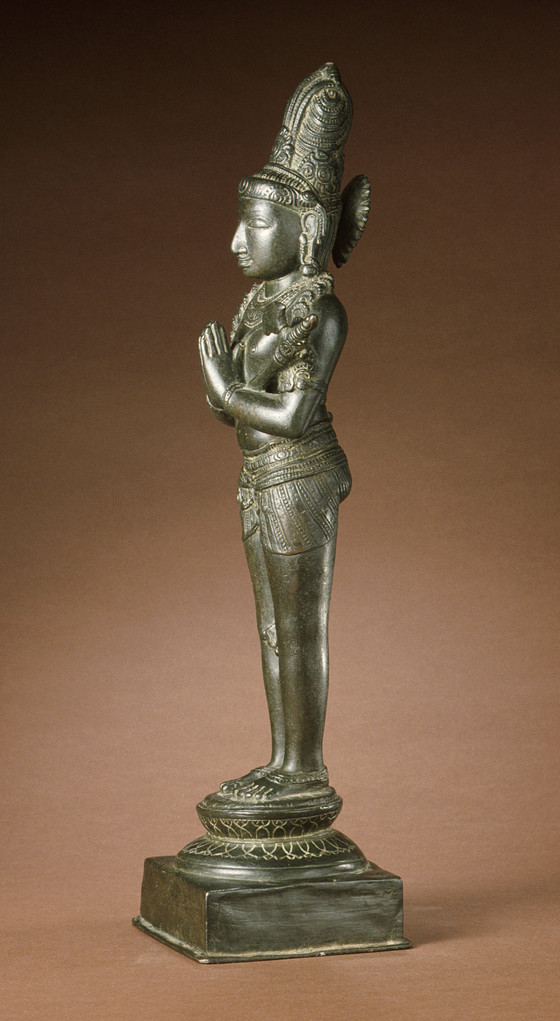
The Hindu Saint Chandikeshvara
* Nearly 20,000 images of artworks the museum believes to be in the public domain are available to download on this site. Other images may be protected by copyright and other intellectual property rights. By using any of these images you agree to LACMA's Terms of Use.

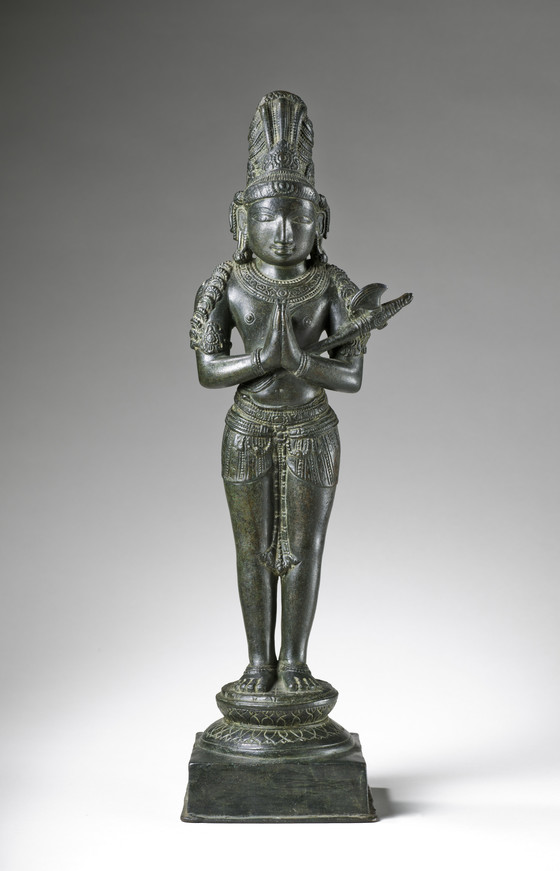
The Hindu Saint Chandikeshvara

India, Tamil Nadu, 1645-1815
Sculpture
Copper alloy
16 1/2 x 5 x 4 3/8 in. (41.91 x 12.7 x 11.11 cm)
Gift of Eivor and Dr. Alston Callahan, Birmingham, Alabama (M.84.216)
Not currently on public view

Curator Notes

The Hindu saint Chandikeshvara (also known as Chandeshvara or Chandesha) was one of the sixty-three Nayanars (or Nayanmars; “teachers of Shiva”), who were Shaiva saints in Tamil Nadu in the 6th-8th ce...
The Hindu saint Chandikeshvara (also known as Chandeshvara or Chandesha) was one of the sixty-three Nayanars (or Nayanmars; “teachers of Shiva”), who were Shaiva saints in Tamil Nadu in the 6th-8th centuries. His birth name was Vicharasarman (or Visarasarman). When he was a young boy, after observing that his family’s cows were being unattended, he began to care for the cows himself. The cows then began to produce extra milk, which he used to bathe a Shivalinga made of sand. When his father Datta discovered that the boy was inappropriately wasting the milk in this fashion, he scolded him and kicked the sand linga. In retaliation, Vicharasarman struck his father’s leg with a staff, which turned into an axe and severed the limb. Shiva then appeared, blessed the boy, and restored the father’s leg. Chandikeshvara has an ascetic’s piled hair (jata mukuta) with two long ponytails draped over his shoulders. He is heavily ornamented and wears a short dhoti. He stands in a stiff, frontal pose (samapada sthanaka) on a double lotus base. His hands are held in the gesture of adoration (anjali mudra) and he carries an axe (parashu) in the crook of his left arm. Although the bronze was previously attributed to the 13th century (Pal 1988, pp. 283-284, no. 151), a thermoluminescence test of the core indicates that it was created in 1645-1815.
More...

Bibliography

  • Pal, Pratapaditya; Dehejia, Vidya; Slusser, Mary Shepherd; Fisher, Robert E.; Brown, Robert L. Arts of Asia 15 (6): 68-125 (November- December 1985).
  • Pal, Pratapaditya. Indian Sculpture, vol.2. Los Angeles: Los Angeles County Museum of Art; University of California Press, 1988.