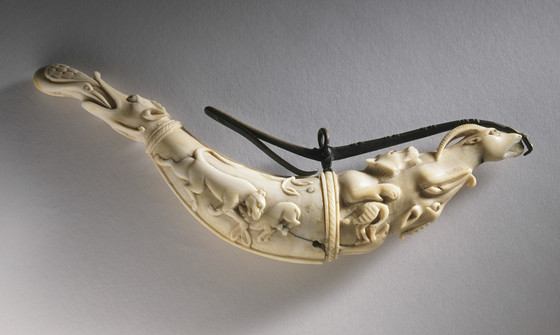
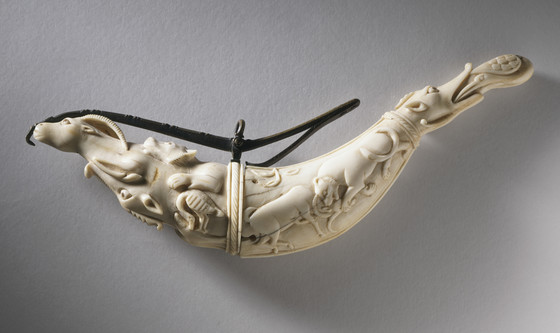
Powder Primer Flask (baruddan)
* Nearly 20,000 images of artworks the museum believes to be in the public domain are available to download on this site. Other images may be protected by copyright and other intellectual property rights. By using any of these images you agree to LACMA's Terms of Use.

Powder Primer Flask (baruddan)

India, Mughal Empire, late 17th century
Arms and Armor; powder primer flasks
Ivory with gilt metal spanner
2 7/8 x 8 1/4 x 1 3/16 in. (7.3 x 20.96 x 3.02 cm)
Gift of Corinne and Don Whitaker (M.83.218.6)
Not currently on public view

Curator Notes

...
This powder primer flask has two reservoir chambers joined in the middle. The priming powder was dispensed from the terminal in the form of an antelope’s head. The antelope has a composite body composed of real and imaginary animals. (For information on South Asian composite creatures, see M.80.226.1.) The lower compartment is enlivened with scenes of animal combat: a lioness bites the neck of a buffalo and a lioness similarly attacks a hare. The lower terminal is in the form of a heron being swallowed by a makara (mythical aquatic creature). A gilt metal spanner functions as a lever that pivots on a hinge to disengage the stopper by compressing the torsion spring handle. A suspension loop enabled the flask to be attached to a waist sash. Powder primer flasks were used to prime the flashpan and touchhole of early muskets. The weapons were fired by igniting the priming powder, in turn detonating the charge powder, which was loaded from larger containers known as powder horns. South Asian primer flasks are made of a variety of materials, including ivory, jade, nautilus shells, and ibex horns. Ivory primer flasks fashioned in the shape of an antelope and decorated with lively hunting scenes are significant for being among the earliest Mughal decorative objects known to have reached Europe in the mid-17th and early 18th centuries. Stylistic relationships with paintings and extant drawings of primer flasks suggest that pictorial artists may have participated in their design.
More...

Bibliography

  • Pal, Pratapaditya.  Elephants and Ivories in South Asia.  Los Angeles: Los Angeles County Museum of Art, 1981.
  • Markel, Stephen.  "The Use of Flora and Fauna Imagery in Mughal Decorative Arts."  Marg 50, no. 3 (March 1999).