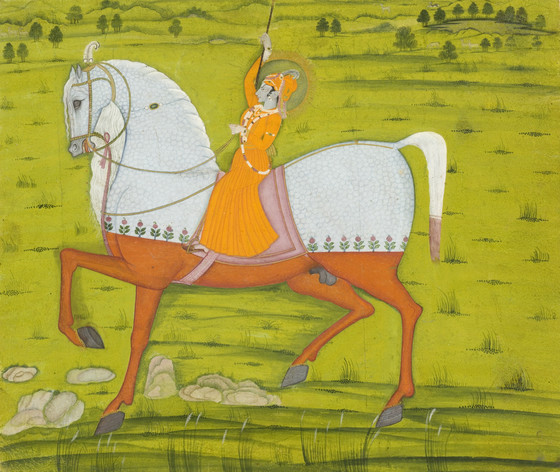
Maharaja Savant Singh of Kishangarh (r. 1748-1757) as Krishna on Horseback
* Nearly 20,000 images of artworks the museum believes to be in the public domain are available to download on this site. Other images may be protected by copyright and other intellectual property rights. By using any of these images you agree to LACMA's Terms of Use.

Maharaja Savant Singh of Kishangarh (r. 1748-1757) as Krishna on Horseback

India, Rajasthan, Kishangarh, circa 1750-1800
Drawings; watercolors
Opaque watercolor and gold on paper
9 1/4 x 10 7/8 in. (23.5 x 27.62 cm)
From the Nasli and Alice Heeramaneck Collection, Museum Associates Purchase (M.83.105.14)
Not currently on public view

Curator Notes

Maharaja Savant Singh of Kishangarh (r. 1748-1757) was born in 1700 in Rupnagar....
Maharaja Savant Singh of Kishangarh (r. 1748-1757) was born in 1700 in Rupnagar. After serving in the Mughal army, he was formally invested as the Maharaja of Kishangarh by the Mughal Emperor Muhammad Shah (r. 1719-1748) in Delhi in 1748 upon the death of his father Maharaja Raj Singh (r. 1706-1748). His younger brother, Maharaja Bahadur Singh (r. 1748-1781), however, usurped the throne and contested his right to rule until they agreed to a settlement in 1756. Savant Singh retained control over Rupnagar, but ceded his executive authority over Kishangarh to his son Sardar Singh, who ruled as Regent until his father’s death in 1765 and then as Maharaja (r. 1765-1768). In 1757 Savant Singh retired to Vrindaban, the pastoral homeland of Krishna near Mathura, Uttar Pradesh, with his lover Rasik Behari, a poetess and singer known as "Bani Thani" (well-dressed). Writing under his pen name Nagaridas, Savant Singh composed devotional poems (and commissioned paintings) celebrating the love of Krishna and Radha as a metaphor for his own deep love for Bani Thani (see M.89.51.2 and AC1999.264.1). In this allegorical painting, the nimbate Savant Singh is portrayed as Krishna, the blue-skinned Hindu god of devotion. He wears an orange coat and an orange turban adorned with a feather plume and a jigha (plume-like ornament similar to an aigrette). Carrying a lance, he rides a magnificent dappled stallion whose underside is conventionally painted red to symbolize its martial prowess.
More...

Bibliography

  • Rosenfield, John.  The Arts of India and Nepal: The Nasli and Alice Heeramaneck Collection.  Boston:  Museum of Fine Arts, Boston, 1966.