

Curator Notes
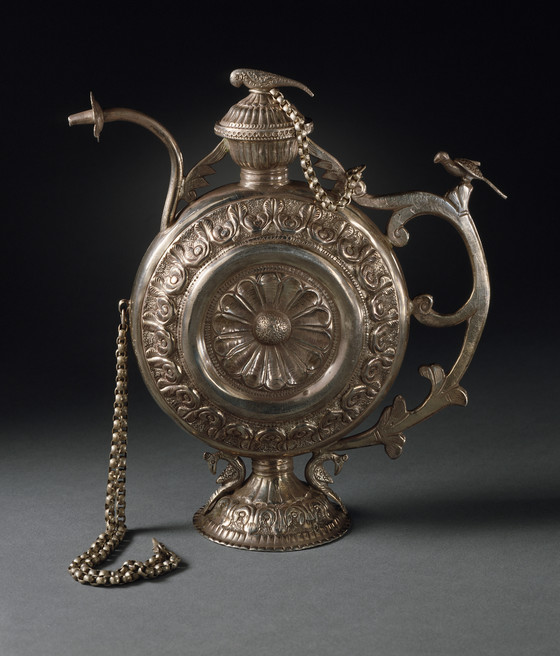
The ewer has a circular body over a pedestal foot supported by two peacocks. It has a short neck with a bowl-shaped ribbed mouth and dome-shaped ribbed cover surmounted by a parrot. The handle is fashioned in the form of a foliated vine with a parrot perched on its uppermost bract. Split-leaf forms support the mouth and the spout. The spout is curvilinear and embellished with an open blossom near its end. Chains connect the stopper to the spout and the cover to the handle.
The body of the vessel is adorned with concentric rings of floral and vegetal decoration. The center is a large blossom. It is surrounded by a punch-marked border, a plain band, and another punch-marked border. The outer ring is a band of stylized acanthus leaves set against a stippled ground. The pedestal foot is decorated with stylized acanthus leaves and ribbing.
The flat circular body of this ewer has a widespread heritage. Metal and ceramic vessels of a similar round shape were used as canteens or wine flasks in the Islamic world, India, and China as early as the 12th century. Developing from those earlier traditions but influenced by Sultanate and Mughal ewer forms (see AC1995.52.1) are round beer vessels made in Tibet in the 18th and 19th centuries. Ultimately, vessels with circular bodies may derive from related leather and camel skin vessels, later examples of which survive from the 19th century. Ewers made in this distinctive form are sometimes described as a decanter (chuski).
More...