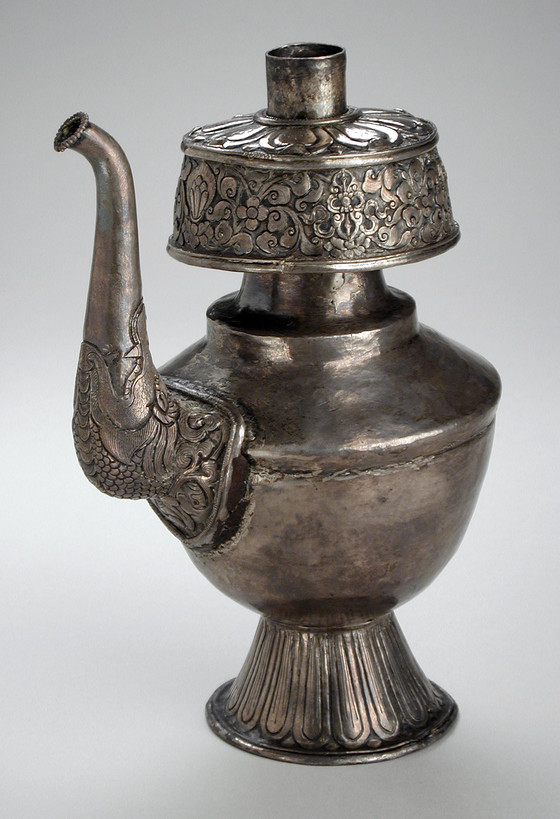
Vase of Immortality (Tshe-bum)
* Nearly 20,000 images of artworks the museum believes to be in the public domain are available to download on this site. Other images may be protected by copyright and other intellectual property rights. By using any of these images you agree to LACMA's Terms of Use.

Vase of Immortality (Tshe-bum)

Eastern Tibet, 18th century
Furnishings; Accessories
Silver, repoussé and cast
Height: 7 7/8 in. (20 cm); Diameter: 4 7/8 in. (12.38 cm)
Purchased with funds provided by The Louis and Erma Zalk Foundation (M.83.2.1a-b)
Not currently on public view

Curator Notes

...
A Tibetan Vase of Immortality (Tshe-bum) is a type of ewer used in longevity rituals to dispense sacred water symbolizing the elixir of immortality (amrita). It is principally associated with Amitayus, the Buddha of Eternal Life (see M.84.32.5 and M.77.19.14). Usually peacock feathers, whose eyespots or ocelli symbolize the transcendental insights of the Five Jina Buddhas, are placed in a vase. The plain bowl-shaped body of the vase has sloped shoulders and a stepped neck. It is supported by a flaring pedestal foot adorned with lotus petals. The vessel has a silver spout issuing out of the mouth of a mythical aquatic creature (makara). The flat-topped lid has a band of lotus petals and an overhanging fringe adorned with the Buddhist Eight Auspicious Symbols set in a field of scrolling foliage. It has a short, vertical open mouth used to insert the peacock feathers. See also M.2011.157.3a-c. For painted representations of this form of ewer, see M.83.105.18 (top left) and M.86.292 (illustration of the King of Guge, deposed 1630).  
More...

Bibliography

  • Pal, Pratapaditya. Art of Tibet. Expanded edition. Los Angeles: Los Angeles County Museum of Art, 1990.