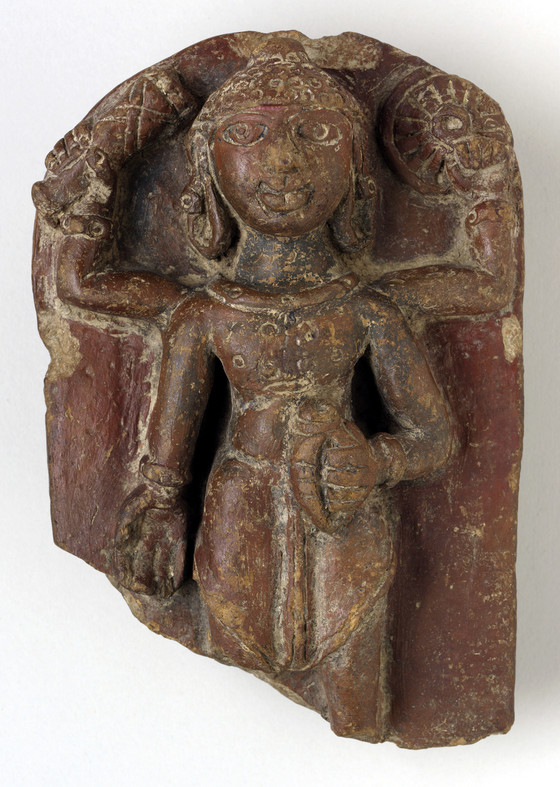
Vamana, the Dwarf Avatar of Vishnu
* Nearly 20,000 images of artworks the museum believes to be in the public domain are available to download on this site. Other images may be protected by copyright and other intellectual property rights. By using any of these images you agree to LACMA's Terms of Use.

Vamana, the Dwarf Avatar of Vishnu

India, Madhya Pradesh, circa 400
Sculpture
Dark brown earthenware relief tile with traces of paint
7 3/4 x 5 1/4 x 2 3/16 in. (19.68 x 13.33 x 5.55 cm)
Christian Humann Memorial Fund (M.81.240)
Not currently on public view

Curator Notes

...
In his fifth incarnation (avatar), Vishnu, the Hindu God of Preservation, manifested as the dwarf Vamana to thwart the grandiose sacrifice of the demon king Bali who had defeated Indra, the King of the Gods, and assumed his throne in the heavens of the gods (Indraloka or Svarga). When Bali offered the lowly Vamana anything of his choosing, Vamana humbly asked for all the land he could cover in three steps. After Bali granted his request, Vamana instantly transformed himself in the colossal Trivikrama (The Taker of Three Steps). His first step encompassed the earth, his second step traversed the entire sky, and his third step enveloped the celestial regions. Bali was thus defeated and relegated to rule a minor domain. Vamana is represented here as standing in a stiff, frontal pose (samapada sthanaka). He has short curly hair similar to a Buddha or Jina and a cranial protuberance similar to a Buddha’s ushnisha that evokes the topknot of a Brahmacharin (religious student in the Brahmacharya Ashram stage of life). He has four arms. In his upper right hand, he holds Vishnu’s mace (gada). His lower right hand is held in the gesture of charity (varada mudra). In his upper left hand, he holds Vishnu’s discus (chakra). His lower left hand carries Vishnu’s conch (shankha). Pratapaditya Pal has suggested that this image is an emanation (vyuha) of Vishnu rather than an incarnation (avatar) because he carries Vishnu’s attributes and is not a dwarf (Pal 1986, p. 241, no. S117). This assumption cannot be validated for several reasons. Vishnu’s 24 emanations (chaturvimshati-murti) all carry Vishnu’s four primary attributes held in varying hands, but this image omits the lotus (padma) attribute. The 24 emanations are all crowned, whereas this image is uncrowned. Due to the damage on the bottom of the relief, the figure’s dwarfism is inconclusive. See also M.84.58.1, M.84.221.3, M.91.294.1, AC1993.54.1, and AC1994.4.1.
More...

Bibliography

  • Pal, Pratapaditya. Indian Sculpture, vol.1. Los Angeles: Los Angeles County Museum of Art; University of California Press, 1986.