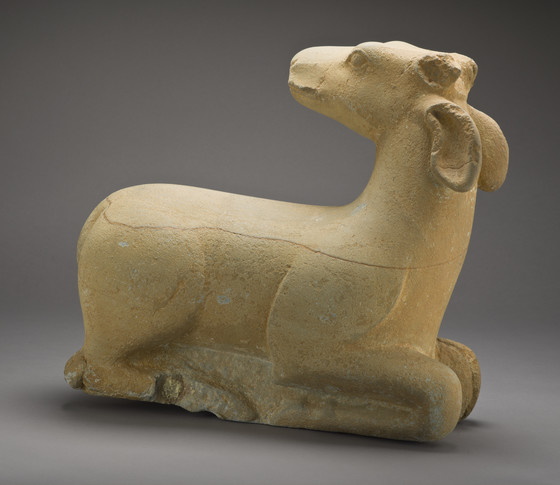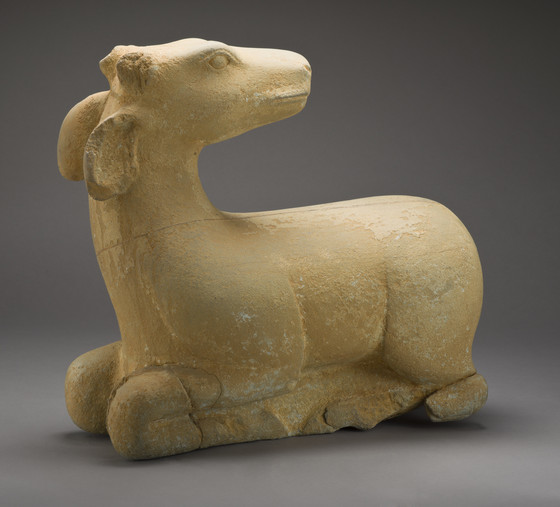
Couchant Deer

* Nearly 20,000 images of artworks the museum believes to be in the public domain are available to download on this site. Other images may be protected by copyright and other intellectual property rights. By using any of these images you agree to LACMA's Terms of Use.

Couchant Deer

Thailand, Mon-Dvaravati, 7th-8th century
Sculpture
Sandstone
14 7/8 x 15 3/4 x 5 7/8 in. (37.78 x 40 x 14.92 cm)
Gift of Mr. and Mrs. Harry Lenart (M.81.157.1)
Currently on public view:
Resnick Pavilion, floor 1

Since gallery displays may change often, please contact us before you visit to make certain this item is on view.

Curator Notes

This couchant deer carved of sandstone is one of a group of sculptures created in central Thailand during the Mon-Dvaravati Kingdom (7th-9th century)....
This couchant deer carved of sandstone is one of a group of sculptures created in central Thailand during the Mon-Dvaravati Kingdom (7th-9th century). They evoke the Buddha Shakyamuni’s First Sermon after he achieved Enlightenment, which he preached in a peaceful ashram named the Deer Park at Sarnath, Uttar Pradesh, India. Similar deer flanking the Buddhist Wheel of the Law (Dharma Chakra) are found in countless reliefs throughout Asia. Only in Thailand, however, are the deer represented fully sculpted in the round and freestanding. Another Thai innovation, apart from parallel but unconnected examples found in the art of ancient Gandhara (present-day northwest Pakistan and northeast Afghanistan) in the 3rd century BCE-3rd century CE, is that the Dvaravati deer feature a back-turned head. Previously, the deer were generally represented facing or looking up at the Wheel rather than looking towards the rear. Other stylistic characteristics of the naturalistically rendered Dvaravati deer include their kneeling front legs, lowered ears, outlined eyes, lowered tail, and short projections for horns (possibly with metal or wood horns separately attached). The LACMA deer’s horns are now damaged. Although a direct artistic source for the Dvaravati deer is yet to be determined, they were clearly important and popular visual symbols of Buddhist doctrine. (Brown 2013)
More...

Bibliography

  • Brown, Robert L. Southeast Asian Art at LACMA: An Online Scholarly Catalogue. Los Angeles: Los Angeles County Museum of Art, 2013. Accessed June 25, 2024. http://seasian.catalog.lacma.org/.

  • Brown, Robert L. Southeast Asian Art at LACMA: An Online Scholarly Catalogue. Los Angeles: Los Angeles County Museum of Art, 2013. Accessed June 25, 2024. http://seasian.catalog.lacma.org/.

  • Little, Stephen, Tushara Bindu Gude, Karina Romero Blanco, Silvia Seligson, Marco Antonio Karam. Las Huellas de Buda. Ciudad de México : Instituto Nacional de Antropología e Historia, 2018.
  • Little, Stephen, and Tushara Bindu Gude. Realms of the Dharma: Buddhist Art across Asia. Los Angeles: Los Angeles County Museum of Art, 2025.
  • Pal, Pratapaditya; Dehejia, Vidya; Slusser, Mary Shepherd; Fisher, Robert E.; Brown, Robert L. Arts of Asia 15 (6): 68-125 (November- December 1985).
More...