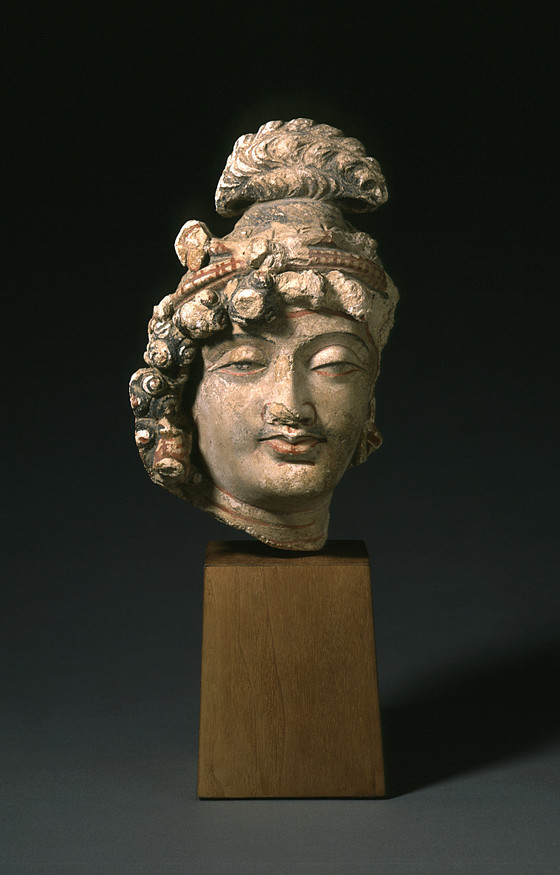
Head of a Bodhisattva
* Nearly 20,000 images of artworks the museum believes to be in the public domain are available to download on this site. Other images may be protected by copyright and other intellectual property rights. By using any of these images you agree to LACMA's Terms of Use.

Head of a Bodhisattva

Afghanistan, Nangarhar Province, Hadda, Gandhara region, 4th-5th century
Sculpture
Stucco with paint
10 3/4 x 6 1/4 x 5 1/2 in. (27.31 x 15.88 x 13.97 cm)
From the Nasli and Alice Heeramaneck Collection, Museum Associates Purchase (M.80.6.4)
Currently on public view:
Resnick Pavilion, floor 1

Since gallery displays may change often, please contact us before you visit to make certain this item is on view.

Curator Notes

This head of a Buddhist bodhisattva (one whose essence is goodness) is from Afghanistan, likely from the ancient monastic site of Hadda near Jalalabad where thousands of stucco and clay sculptures exe...
This head of a Buddhist bodhisattva (one whose essence is goodness) is from Afghanistan, likely from the ancient monastic site of Hadda near Jalalabad where thousands of stucco and clay sculptures executed in Indo-Hellenistic style and painted with brilliant polychrome were recovered. Bodhisattvas, who postpone their final enlightenment to help all sentient beings achieve their own awakening, are portrayed as elegant noblemen or noble women with contemporary Greco-Roman jewelry and clothing conventions. This fashionably styled head has a fan-shaped topknot fastened by a double band of fabric or twisted cord. Curled rings of hair hang down on the right side of the face. The right ear ornament is in the form of a winged lion. Black and red paint embellish the visage, either by highlighting or outlining the facial features. A characteristic of Gandharan sculpture is that sophisticated anamorphic techniques, typically foreshortening and oblique perspective, are often used to accommodate the intended viewer's perspective. Here, the heavily-lidded pensive eyes gaze in slightly different directions and the sacred forehead marking (urna) is offset from the vertical axis. These distorted figural forms appear correctly oriented when viewed from below and to the side.
More...

Bibliography

  • Little, Stephen, Tushara Bindu Gude, Karina Romero Blanco, Silvia Seligson, Marco Antonio Karam. Las Huellas de Buda. Ciudad de México : Instituto Nacional de Antropología e Historia, 2018.
  • Little, Stephen, and Tushara Bindu Gude. Realms of the Dharma: Buddhist Art across Asia. Los Angeles: Los Angeles County Museum of Art, 2025.
  • Little, Stephen, Tushara Bindu Gude, Karina Romero Blanco, Silvia Seligson, Marco Antonio Karam. Las Huellas de Buda. Ciudad de México : Instituto Nacional de Antropología e Historia, 2018.
  • Little, Stephen, and Tushara Bindu Gude. Realms of the Dharma: Buddhist Art across Asia. Los Angeles: Los Angeles County Museum of Art, 2025.
  • Dohanian, D.K.  The Art of India.  Rochester, NY:  Memorial Art Gallery of the University of Rochester, University Publications, 1961.
  • Rosenfield, John.  The Arts of India and Nepal: The Nasli and Alice Heeramaneck Collection.  Boston:  Museum of Fine Arts, Boston, 1966.
  • Pal, Pratapaditya. Indian Sculpture, vol.1. Los Angeles: Los Angeles County Museum of Art; University of California Press, 1986.
More...