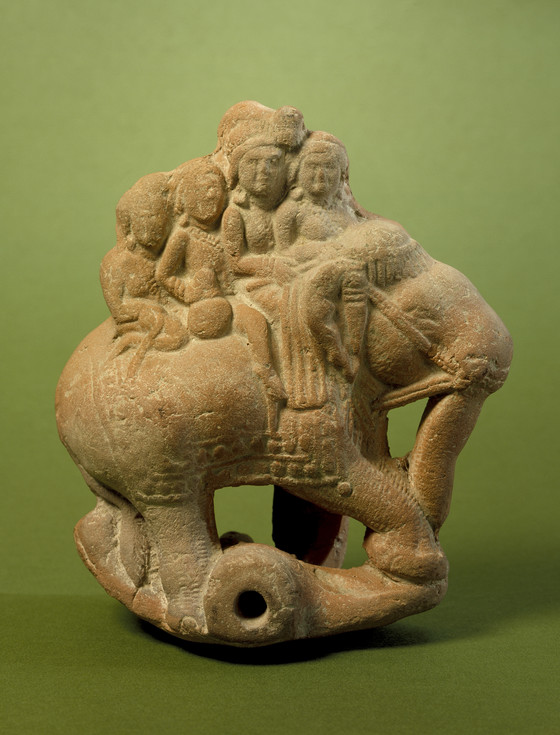
This earthenware representation of an elephant with royal riders was molded in two sections (front and back) and then joined to create a sculpture in the round....
This earthenware representation of an elephant with royal riders was molded in two sections (front and back) and then joined to create a sculpture in the round. The horizontal lug with an axle hole in the base indicates that the object was originally a rocking toy fitted with wheels (see also M.84.220.8). A turbaned Prince sits between two women on a caparisoned elephant with what may be a martingale strap under its neck used to control its head position. A mahout rides at the rear.
Royal riders on elephant back coming in processions to venerate the Buddha were a common motif on gateways to Buddhist funerary monuments (stupas). It has been suggested that this earthenware elephant with royal riders may depict the transportation of Buddhist relics, as the woman seated behind the turbaned Prince carries a covered urn like the type used to carry the Buddha’s relics (see M.84.151). (See Stanislaw J. Czuma, Kushan Sculpture: Images from Early India (Cleveland: Cleveland Museum of Art in association with Indiana University Press, 1985), pp. 116-117, no. 46.) Earthenware plaques depicting an elephant with royal riders from Kaushambi, attributed to the Shunga Dynasty (circa 185-73 BCE), have also been interpreted as King Udayana abducting Princess Vasavadatta, the daughter of King Mahasena of Avanti. (See Martin Lerner and Steven Kossak, The Lotus Transcendent: Indian and Southeast Asian Art from the Samuel Eilenberg Collection (New York: Metropolitan Museum of Art, 1991), pp. 57-58, no. 14; and Satish Chandra Kala, Terracotta Figurines from Kaushambi (Allahabad: Municipal Museum, 1950), pp. 39-40, 133, 135, Pls. XXX and XXXI.) Given that the LACMA portrayal was a rocking toy, however, suggests that the subject of an elephant with riders was also used for secular objects made for a child’s enjoyment.
Comparable toy elephants with riders are in the Metropolitan Museum of Art, New York (1987.142.378) and Allahabad Museum, Prayagraj (529). (See Kala 1950, pp. 40-41, 181, Pl. LIII-A1.)
More...