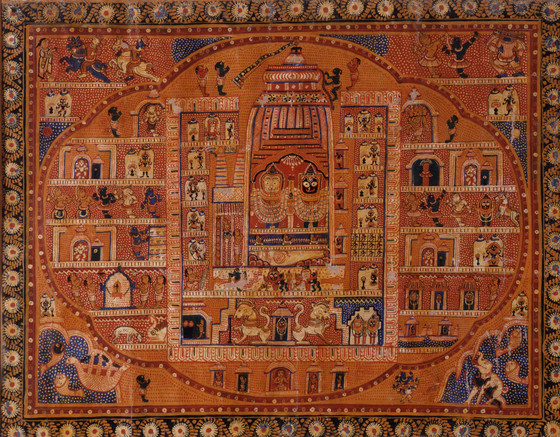
Jagannatha, Balabhadra, and Subhadra in the Jagannatha Temple
* Nearly 20,000 images of artworks the museum believes to be in the public domain are available to download on this site. Other images may be protected by copyright and other intellectual property rights. By using any of these images you agree to LACMA's Terms of Use.

Jagannatha, Balabhadra, and Subhadra in the Jagannatha Temple

India, Odisha (Orissa), Puri, circa 1875-1900
Drawings; watercolors
Opaque watercolor on cloth
Image (Image): 22 1/2 x 29 in. (57.15 x 73.66 cm) Sheet (Sheet): 23 1/4 x 29 3/4 in. (59.055 x 75.565 cm) Frame: 31 × 41 1/4 × 2 in. (78.74 × 104.78 × 5.08 cm)
Indian Art Special Purpose Fund (M.82.107)
Not currently on public view

Curator Notes

At the center of this detailed depiction of the Jagannath temple and its subsidiary shrines in Puri, Odisha (Orissa), stand its distinctive icons Jagannath (Krishna), Balabhadra (Balarama), and Subhad...
At the center of this detailed depiction of the Jagannath temple and its subsidiary shrines in Puri, Odisha (Orissa), stand its distinctive icons Jagannath (Krishna), Balabhadra (Balarama), and Subhadra (sister of Krishna and Balarama). The conch shell below the icons represents the land of Puri. The ten avatars of Vishnu are represented in a horizontal band to either side of the main deities, with Jagannath replacing the Buddha and Kalki represented simply by a white horse. This type of Puri pilgrimage painting, with the images portrayed in a central shrine embedded in the sloping spire of the temple with subsidiary shrines and details included, was introduced during the 19th century. Paintings like this one were produced by the hundreds for sale to pilgrims as reminders of their visit to Puri during the Jagannath festival. It was customary for every pilgrim on returning from Puri to send one of these pictures and a few grains of the dried cooked rice from the temple, to his or her friends and relatives according to their means. See also M.82.107, M.2003.215, and M.2006.180.3.
More...