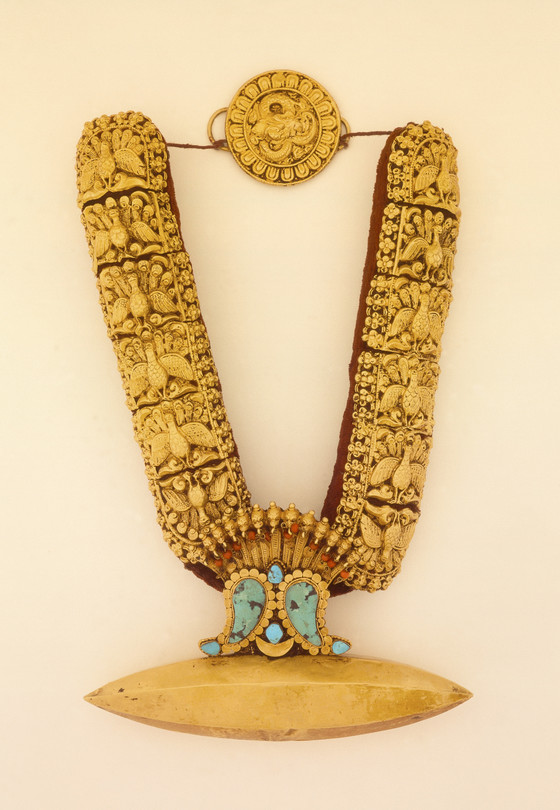
Necklace for the Living Goddess
* Nearly 20,000 images of artworks the museum believes to be in the public domain are available to download on this site. Other images may be protected by copyright and other intellectual property rights. By using any of these images you agree to LACMA's Terms of Use.

Necklace for the Living Goddess

Nepal, Kathmandu Valley, circa 19th century
Jewelry and Adornments
Gold and gilt copper alloy cast and repoussé; inlaid with turquoise and coral
13 1/2 x 6 3/4 x 2 in. (34.29 x 17.14 x 5.08 cm)
Purchased with funds provided by Camilla Chandler Frost (M.79.242)
Not currently on public view

Curator Notes

...
This is the distinctive ceremonial necklace (tayo) of Nepal’s Living Goddess, Kumari Devi, who is a manifestation of the Hindu great goddess Durga in her form as the protective goddess Taleju. It is also worn by brides and elite Newar women (see M.91.134). The lozenge-shaped horizontal pendant is an amulet container for symbolic grains of purified rice, gemstones, or a sacred verse. Surmounting it are a pair of comma-shaped turquoise plaques (paleswan-ha) set between sun and crescent moon symbols. They are reminiscent of the protective tiger-claw necklace pendants worn by Kumara (also known Skanda or Karttikeya), the Hindu god of war, as well as by Manjushri, the bodhisattva of wisdom (see M.81.3.1a-b). Rising above the grouping are thirteen rearing cobra heads with dangling coral beads symbolic of the serpents’ guarded treasures. The broad support "chains" of the necklace are adorned on each side with six repoussé panels of peacocks spreading their trains or tail feathers. Peacocks are the mount and, hence, symbolic of Kumara (see AC1994.183.1), and also his skati (female creative energy), Kaumari, a violent (ugra) form of Durga (see M.82.42.3) and a member of the Seven Mother Goddesses (Sapta Matrikas; see M.71.110.2 and (M.80.157). The lowest peacocks on the supports are inverted for design purposes. The backside of the supports is a padded textile mount. The lotiform medallion clasp has a writhing dragon in the center of a band of lotus petals. Comparable tayo necklaces are in the Seattle Art Museum (33.704) and illustrated in Hannelore Gabriel, The Jewelry of Nepal (New York: Weatherhill, 1999), pp. 67-71; and John Clarke, Jewellery of Tibet and Himalayas (London: V&A Publications, 2004), p. 60, fig. 42. See also Katherine Anne Paul, "Tayo-bizakani Ritual Necklace with Naga, Peacock, and Dragon Motifs: The Multifaceted Power of Ornament," Project Himalayan Art (New York: Rubin Museum of Art, 2023), https://rubinmuseum.org/projecthimalayanart/essays/tayo-bizakani-ritual-necklace-with-naga-peacock-and-dragon-motifs/.
More...

Bibliography

  • Pal, Pratapaditya. Art of Nepal. Los Angeles: Los Angeles County Museum of Art; University of California Press, 1985.
  • Gabriel, Hannelore.  The Jewelry of Nepal.  New York: Weatherhill, Inc., 1999.
  • Huntington, John C. and Dina Bangdel.  The Circle of Bliss:  Buddhist Meditational Art.  Columbus:  The Columbus Museum of Art; Chicago:  Serindia Publications, 2003.
  • Pal, Pratapaditya. Art of Nepal. Los Angeles: Los Angeles County Museum of Art; University of California Press, 1985.
  • Gabriel, Hannelore.  The Jewelry of Nepal.  New York: Weatherhill, Inc., 1999.
  • Huntington, John C. and Dina Bangdel.  The Circle of Bliss:  Buddhist Meditational Art.  Columbus:  The Columbus Museum of Art; Chicago:  Serindia Publications, 2003.
  • "Gold Treasures: Los Angeles County Museum of Art." The India Magazine of Her People and Culture 12, no.1 (1991): 78-79.
More...