Assumption of the Virgin Mary
* Nearly 20,000 images of artworks the museum believes to be in the public domain are available to download on this site. Other images may be protected by copyright and other intellectual property rights. By using any of these images you agree to LACMA's Terms of Use.

Assumption of the Virgin Mary

India, Delhi, Mughal Empire, 18th century
Drawings
Ink on paper
10 3/8 x 6 7/8 in. (26.35 x 17.46 cm)
Gift of Paul F. Walter (M.75.113.1)
Not currently on public view

Curator Notes

The Assumption of the Virgin Mary is one of the four Marian dogmas of the Catholic Church....
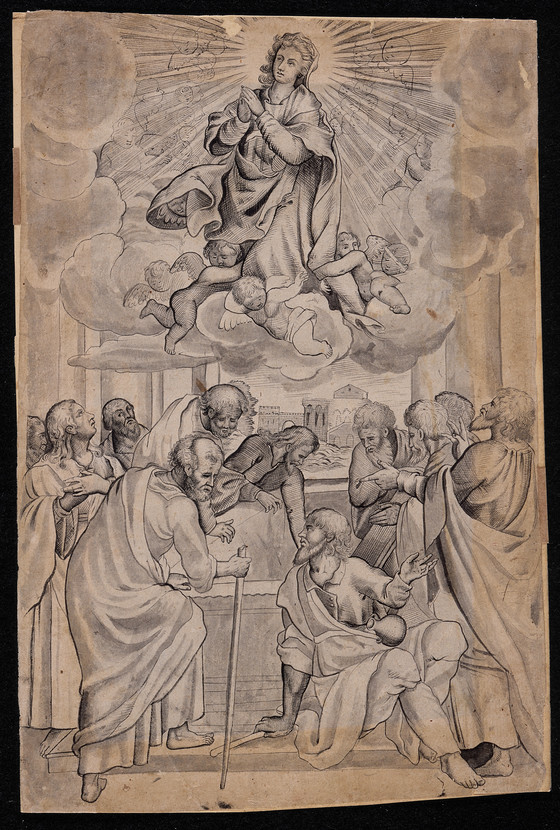
The Assumption of the Virgin Mary is one of the four Marian dogmas of the Catholic Church. Although not mentioned in the New Testament, in Western Christian art during the 12th century it became a popular narrative scene from the Life of the Virgin Mary. In the Renaissance art of the 15th-16th centuries, representations of the Assumption are sometimes conflated with her Coronation as the Queen of Heaven. The Assumption was a common subject for illustrating the ceilings of Christian cathedrals. In this Mughal copy of an unidentified European engraving, the Virgin is being borne aloft by cherubim (putti) to Heaven, where she is to be crowned by Christ. She radiates a corona of light, and her hands are clasped in prayer in the iconographic tradition of medieval European images of the Assumption. Beneath her, the Twelve Apostles gather around her empty tomb. They either stare up in awe at the Virgin or are weeping. A European fortress is visible in the distant background in the center of the composition. The composition, figures, modeling, architecture, and perspective are rendered in a faithful Western artistic style, rather than some of the elements being Indianized as done in M.75.113.4 See also M.83.105.5a-b.
More...

Bibliography

  • Larson, Gerald et al.  In Her Image:  The Great Goddess in Indian Asia and the Madonna in Christian Culture.  Santa Barbara:  UCSB Art Museum, University of California, 1980.