Shankarabharana Ragaputra, Seventh Son of Megha Raga, Folio from a Ragamala (Garland of Melodies)
* Nearly 20,000 images of artworks the museum believes to be in the public domain are available to download on this site. Other images may be protected by copyright and other intellectual property rights. By using any of these images you agree to LACMA's Terms of Use.

Shankarabharana Ragaputra, Seventh Son of Megha Raga, Folio from a Ragamala (Garland of Melodies)

India, Maharashtra, Aurangabad, circa 1670
Drawings; watercolors
Opaque watercolor, gold, lapis lazuli, and ink on paper
Sheet: 13 1/2 x 9 3/16 in. (34.29 x 23.34 cm); Image: 10 1/2 x 7 5/8 in. (26.67 x 19.37 cm)
Gift of Harry Kahn (M.74.105.1)
Not currently on public view

Curator Notes

According to the Sanskrit inscription and its Persian translation on the reverse, Shankarabharana Ragaputra is the seventh son of Megha Raga....
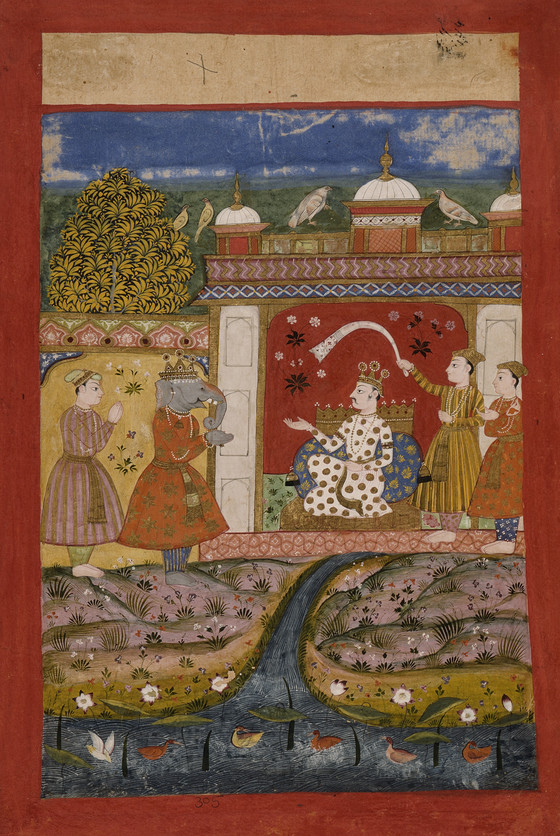
According to the Sanskrit inscription and its Persian translation on the reverse, Shankarabharana Ragaputra is the seventh son of Megha Raga. The description states that before Shankarabharana stands Ganapati (Ganesha), adorned with a gem-encrusted crown, his body ornamented with garlands, with lotus eyes and hands joined together. The imagery here generally accords with the description. Shankarabharana is seated in a pavilion with a cloth fly whisk being waived over his head by an attendant. The elephant-headed Ganesha stands before him with his hands cupped as if to receive an offering. A man stands behind Ganesha with his hands held together in homage. This folio is from a dispersed ragamala series attributed to Aurangabad, Maharashtra, circa 1670. Three other related ragamala series from the same workshop are known. This painting is from a fourth series distinguished by its blind header and bilingual inscriptions on the reverse (Seyller and Mittal 2018). This series is generally thought to be based on the ragamala iconographic system compiled in 1570 by Mesakarna (or Kshemakarna), a priest in Rewa in eastern Bundelkhand. However, as Mesakarna describes the melody as a crowned ascetic chewing beetle nut and holding a lotus, this painting with Ganesha represents a variant interpretation. Additional folios from this series are in the Jagdish and Kamala Mittal Museum of Indian Art, Hyderabad (76.458 D57 and 76.459 D58) and the Asian Art Museum, San Francisco (B84D12).
More...

Bibliography

  • Pal, Pratapaditya, Thomas W. Lentz, Sheila R. Canby, Edwin Binney, 3rd, Walter B. Denny, and Stephen Markel. "Arts from Islamic Cultures: Los Angeles County Museum of Art." Arts of Asia 17, no. 6 (November/December 1987): 73-130.

  • Pal, Pratapaditya, Thomas W. Lentz, Sheila R. Canby, Edwin Binney, 3rd, Walter B. Denny, and Stephen Markel. "Arts from Islamic Cultures: Los Angeles County Museum of Art." Arts of Asia 17, no. 6 (November/December 1987): 73-130.

  • Pal, Pratapaditya. Indian Painting, vol.1. Los Angeles: Los Angeles County Museum of Art, 1993.
More...