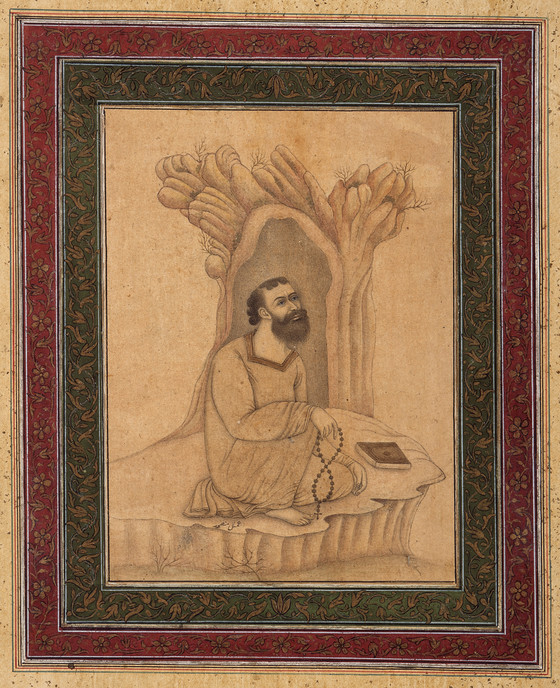
Franciscan Friar

* Nearly 20,000 images of artworks the museum believes to be in the public domain are available to download on this site. Other images may be protected by copyright and other intellectual property rights. By using any of these images you agree to LACMA's Terms of Use.

Franciscan Friar

India, Delhi (?), Mughal Empire, 18th century
Drawings; watercolors
Ink, opaque watercolor, and gold on paper
Image: 6 x 4 1/2 in. (15.24 x 11.43 cm); Sheet: 12 1/2 x 11 in. (31.75 x 27.94 cm)
Gift of Paul F. Walter (M.74.123.1)
Not currently on public view

Curator Notes

This sensitive nim qalam (half-pen) lightly tinted drawing is signed by Mansur....
This sensitive nim qalam (half-pen) lightly tinted drawing is signed by Mansur. It may be an apocryphal signature for the great Mughal artist Mansur (active circa 1589-circa 1626), or it may be by an 18th-century artist of the same name. Pratapaditya Pal and Catherine Glynn have suggested that this is an 18th-century copy of an early 17th-century adaptation of a European print (The Sensuous Line (1976), p. 15, no. 5). Here, an unidentified Franciscan friar, or monk, sits in front of a cave staring piously towards the heavens. He wears a tunic, holds a rosary, and has a Bible beside him. The Franciscan orders of monks and nuns were founded in 1209 by an Italian Catholic friar, St. Francis of Assisi (1182-1232). Franciscans friars were itinerant mendicants who took a vow of poverty and wore simple tunics. They spread the Gospel of Jesus in their travels and ministered to the sick and needy. St Francis of Assisi arrived in the Portuguese Viceroyalty of Goa in 1542 and was instrumental in the spread of Christianity in India, Sri Lanka, and parts of Southeast Asia. The Church and Convent of St. Francis of Assisi in Goa was built originally in 1521 by eight Portuguese Franciscan friars who reached Goa in 1517. The present structure is a replacement dating from 1661, except for the entrance, which is from the original façade. The rib-vaulted nave has a gilded altar, an intricately carved and painted wooden pulpit, and frescoes with scenes from the life of St. Francis.
More...

Bibliography

  • Pal, Pratapaditya and Catherine Glynn.  The Sensuous Line:  Indian Drawings from the Paul F. Walter Collection.  Los Angeles:  Los Angeles County Museum of Art, 1976.