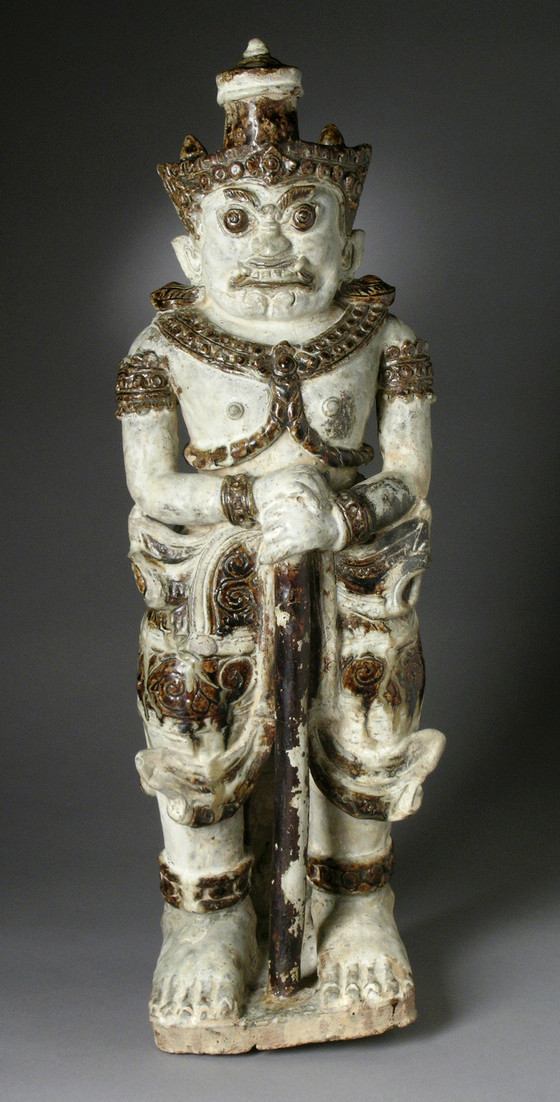
Buddhist Guardian

* Nearly 20,000 images of artworks the museum believes to be in the public domain are available to download on this site. Other images may be protected by copyright and other intellectual property rights. By using any of these images you agree to LACMA's Terms of Use.

Buddhist Guardian

Thailand, Sawankhalok, 16th century
Sculpture
Modeled stoneware with cream slip, underglaze brown painted decoration, and pale blue glaze
22 × 7 3/4 × 6 in. (55.88 × 19.69 × 15.24 cm)
Gift of Margot and Hans A. Ries (M.73.119.14)
Not currently on public view

Curator Notes

...
This Buddhist guardian figure (dvarapala) was likely one of a pair originally situated in front of the entrance to a temple to protect the holy sanctuary from mortal marauders and demonic forces. It was produced in the north-central Thai ceramic producing center of Sawankhalok (derived from the Sanskrit Svaragaloka or "place of heaven"). Sawankhalok was part of the Sukhothai kingdom (1238-1438) and then the Ayutthaya kingdom (1351-1767) after it annexed Sukhothai in 1438. Sawankhalok is estimated to have had 800-900 kilns capable of producing glazed stoneware in its approximate 250-year production history. Sawankhalok wares exhibit a broad spectrum of glaze techniques; vessel, animal, and figural forms; and decorative motifs. Fashioned fully in the round, the crowned guardian has a fierce expression with bulging eyes, bushy eyebrows, and a snarling mouth with fangs, all intended to scare off evil doers. He stands erect in an alert posture and holds a long club between his legs. He wears copious jewelry, including ear ornaments, a cross belt across his chest, waist belt, armlets, bracelets, and anklets. His lower garment is embellished with scrolling floral motifs in brown underglaze. See Virginia Dofflemyer, Southeast Asian Ceramics from the Collection of Margot and Hans Ries (Pasadena: Pacific Asia Museum, 1989), no. 38, frontispiece.
More...