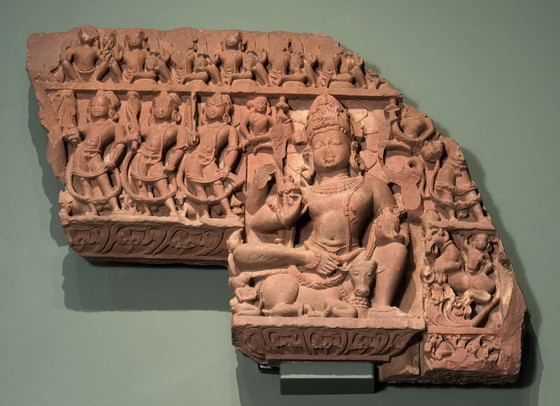
Lintel with Shiva and Subsidiary Deities
* Nearly 20,000 images of artworks the museum believes to be in the public domain are available to download on this site. Other images may be protected by copyright and other intellectual property rights. By using any of these images you agree to LACMA's Terms of Use.

Lintel with Shiva and Subsidiary Deities

India, Rajasthan, Kota region, Atru (?), circa 850-900
Architecture; Architectural Elements
Red sandstone
28 3/4 x 39 x 6 in. (73.02 x 99.06 x 15.24 cm)
From the Nasli and Alice Heeramaneck Collection, Museum Associates Purchase (M.74.5.6)
Not currently on public view

Curator Notes

This frieze was once the right corner section of the extensive lintel and overdoor (uttaranga) decoration of a Vaishnava temple dedicated to Vishnu, who would have been shown to the left of this porti...
This frieze was once the right corner section of the extensive lintel and overdoor (uttaranga) decoration of a Vaishnava temple dedicated to Vishnu, who would have been shown to the left of this portion in the center above the doorway. The main figure here represents Shiva seated on his bull mount, Nandi. He has the piled hair of an ascetic and wears the Brahmanical sacred thread (yajnopavita) over his left shoulder. Shiva has four arms. In his upper right hand, he holds a now-damaged trident (trishula). In his lower right hand, he carries a lotus. In his upper left hand, he holds a now-damaged serpent. In his lower left hand, he carries an ascetic’s waterpot (kamandalu). He is flanked by four of the eight Guardians of the Directions (ashta dikpala). Three Guardians are on the left. From left to right, they are Nirriti, Regent of the Southwest, with his sword and a dog mount; Varuna, Regent of the West, with his mythical aquatic creature (makara) mount; and Varuna, Regent of the Northwest, with his standard (dhvaja) and deer mount. On the right of Shiva, is the partially damaged Guardian Kubera, Regent of the North, with his drinking cup in his right hand and a pot of wealth between his legs. On the top of the relief, seven of the nine Indian planetary deities (nava graha) are seated, beginning with the Sun God Surya on the left. In the lower right corner, an attendant rides a rearing leogryph (shardula). This sculpture may have originally been on the same temple as M.74.5.5 and M.77.19.27. A sculpture of Shiva’s Family from the same temple is in the National Museum of Korea (formerly LACMA M.73.4.12). See Vishakha N. Desai and Darielle Mason, eds., Gods, Guardians, and Lovers: Temple Sculptures from North India, A.D. 700-1200 (New York: Asia Society Galleries, in association with Ahmedabad: Mapin Publishing, 1993): 236-237, no. 58.
More...

Bibliography

  • Rosenfield, John.  The Arts of India and Nepal: The Nasli and Alice Heeramaneck Collection.  Boston:  Museum of Fine Arts, Boston, 1966.
  • Trabold, J. The Art of India, An Historical Profile.  Northridge, CA:  California State University Press, 1975.
  • Rosenfield, John.  The Arts of India and Nepal: The Nasli and Alice Heeramaneck Collection.  Boston:  Museum of Fine Arts, Boston, 1966.
  • Trabold, J. The Art of India, An Historical Profile.  Northridge, CA:  California State University Press, 1975.
  • Pal, Pratapaditya. Indian Sculpture, vol.2. Los Angeles: Los Angeles County Museum of Art; University of California Press, 1988.
More...