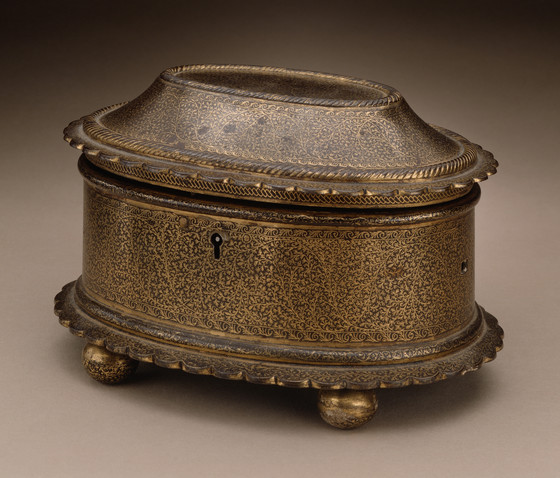
Jewelry Box

* Nearly 20,000 images of artworks the museum believes to be in the public domain are available to download on this site. Other images may be protected by copyright and other intellectual property rights. By using any of these images you agree to LACMA's Terms of Use.

Jewelry Box

Pakistan, Panjab, Sialkot or Gujrat, Kotli Loharan, circa 1850-75
Furnishings; Accessories
Iron overlaid with gold wire
4 1/8 x 6 3/4 x 4 7/8 in. (10.47 x 17.14 x 12.38 cm)
The Nasli M. Heeramaneck Collection, Gift of Joan Palevsky (M.73.5.140)
Not currently on public view

Curator Notes

...
Manufactured in a metalworking technique known as koftgari (made by beating), this oval shaped jewelry box is embellished over most of its surface with foliate motifs of lacelike fineness. The side of the body and the slightly concave sloped top of the lid feature scrolling vegetation. The flat top of the lid has vegetal designs in delicate cartouches. The lid and base have complimenting scalloped rims. Cable molding borders (resembling braided wire) are repeated on the lid. Round balls serve as the feet. The koftgari technique is a type of damascene inlaying that involves incising or cross-hatching a design with a hard steel needle or liner chisel into a ground of iron or mild steel. Pure gold wire or gold leaf is then hammered into the engraved pattern and the whole object is heated, re-hammered, and polished. The technique originated in Iran and was brought to India, where it was used at first to embellish fine arms and armor produced for the Rajput and Sikh rulers and warrior nobles in northern India. After the British annexed the Panjab in 1849 and banned the indigenous production of firearms, the technique was used chiefly by metalworkers in the northern Panjab districts of Sialkot and Gujrat (located in present-day Pakistan) to make myriad types of decorative objects intended for sale to Westerners and for the great exhibitions and world's fairs that were held in Europe and South Asia in the late 19th and early 20th centuries.
More...

Bibliography

  • Pal, Pratapaditya, ed.  Islamic Art:  The Nasli M. Heeramaneck Collection.  Los Angeles:  Museum Associates, 1973.