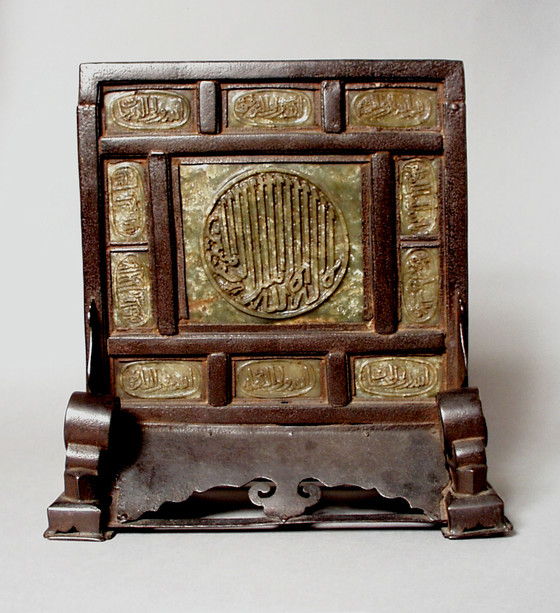
Though this type of tablet is seldom found in the Middle East, it showcases how artists skillfully adapted Islamic calligraphy to fit the material world of southern China.
...
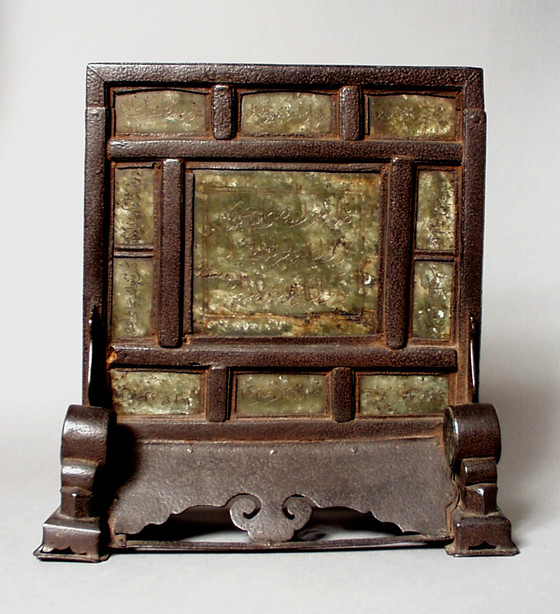
Though this type of tablet is seldom found in the Middle East, it showcases how artists skillfully adapted Islamic calligraphy to fit the material world of southern China. This work of carved jade inscribed in Arabic and set in an iron frame functions as a standing table screen (zuopingfeng). During the Qing dynasty (1644-1912), people of various faiths purchased such table screens to display in their homes. These were fashioned not only from jade, but also marble, ivory, wood, cloisonné, and porcelain with diverse designs, which here clearly demonstrate the influence of Islam though not necessarily the owner’s religion. The Arabic calligraphy in the central panel carries the shahada (Muslim declaration of faith) alongside the names of God in a large medallion, while the Arabic cartouches on the frame panels offer praise to God or else proclaim God’s divine names and titles. The back is inscribed with verses in Persian from the Golistan of Sa’di (d. 1292), likely added by another artisan at a later date. This a rare survival of a table screen containing Arabic script, marking it as a particularly remarkable example from a thriving period for Muslim artisans and Islamic-inspired works in China
Among the most important sources for Chinese jade nephrite were the mountains and rivers of Khotan (present-day Xinjiang province in western China), where its substantial Muslim population became closely intertwined in the jade industry by the time of this object’s creation. Following the Qing conquest of the area in 1759 by the Qianlong emperor, Hongli, the court mobilized local Muslim nobles and commoners to undertake jade extraction in this area. Muslim nobles engaged in every administrative step in the quarrying process from gathering information, and locating reserves, to organizing local laborers. The extracted jade was sent as tribute to the Qing court every spring and autumn, which the emperor proudly celebrated in his poetry.
Uyghur (Turkic Muslim) artisans across China became active participants in the accompanying jade trade as they filled commissions from Qing officials and freely sold their wares on the Chinese market. However, despite its design, the artisan who carved this work need not have been Muslim. Chinese jade craftsmen earned huge profits from making imitations Islamic designs, often from Mughal India and elsewhere. Moreover, the emperor's appreciation for so-called “Islamic-style” jades sparked intense competition between these two groups of craftsmen. Jade table screens gained considerable favor among upper-class consumers in the south, including merchants and scholars.
Owners would often display a table screen in the main living room of a household where a host would receive guests. It typically sat in the middle of the hall upon a side table (changji), flanked by other objects, such as copper and porcelain utensils, or a glass mirror. While decorative in function, the table screen also carries auspicious undertones based on the phrases chosen for its surface. In particular, the panels at the top of the front declare in Arabic, “God is the giver of success,” and “God is the giver of high stations.” These phrases may suggest a tacit desire for such blessings to be bestowed upon the owner’s household. The names of the divine inscribed on this tablet were also believed to hold magical properties in Islamic traditions. Such a work may have attracted Muslim buyers or Chinese intellectuals versed in Arabic and Persian. In either case, the object served as a marker of conspicuous consumption that tied its owner to a circle of wealthy elites.
More...