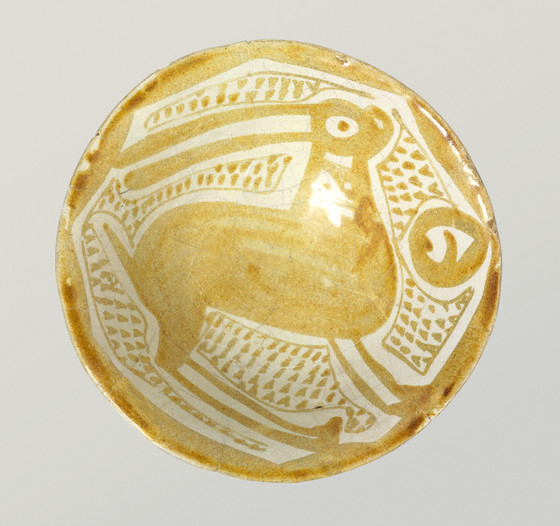
Bowl

* Nearly 20,000 images of artworks the museum believes to be in the public domain are available to download on this site. Other images may be protected by copyright and other intellectual property rights. By using any of these images you agree to LACMA's Terms of Use.

Bowl

Iraq, 10th century
Ceramics
Earthenware, overglaze luster-painted
1 3/4 x 5 1/8 in. (4.45 x 13.02 cm)
The Nasli M. Heeramaneck Collection, gift of Joan Palevsky (M.73.5.272)
Not currently on public view

Curator Notes

Similar to the use of a rabbit’s foot today, the hare was a symbol of good luck in the medieval Islamic world, particularly in Fatimid-controlled Egypt and Syria....
Similar to the use of a rabbit’s foot today, the hare was a symbol of good luck in the medieval Islamic world, particularly in Fatimid-controlled Egypt and Syria. The animal is depicted on many objects from the period, including this luster bowl, where its presence was meant to bring good fortune and perhaps protection to the object’s owner.
More...

Bibliography

  • Lo Terrenal y lo Divino: Arte Islámico siglos VII al XIX Colección del Museo de Arte del Condado de Los Ángeles. Santiago: Centro Cultural La Moneda, 2015.

  • Komaroff, Linda. Beauty and Identity: Islamic Art from the Los Angeles County Museum of Art. Los Angeles: Los Angeles County Museum of Art, 2016.
  • Lo Terrenal y lo Divino: Arte Islámico siglos VII al XIX Colección del Museo de Arte del Condado de Los Ángeles. Santiago: Centro Cultural La Moneda, 2015.

  • Komaroff, Linda. Beauty and Identity: Islamic Art from the Los Angeles County Museum of Art. Los Angeles: Los Angeles County Museum of Art, 2016.
  • Flood, Finbarr Barry, and Beate Fricke. Tales Things Tell: Material Histories of Early Globalisms. Princeton, NJ: Princeton University Press, 2023.
  • Pal, Pratapaditya, ed.  Islamic Art:  The Nasli M. Heeramaneck Collection.  Los Angeles:  Museum Associates, 1973.
More...