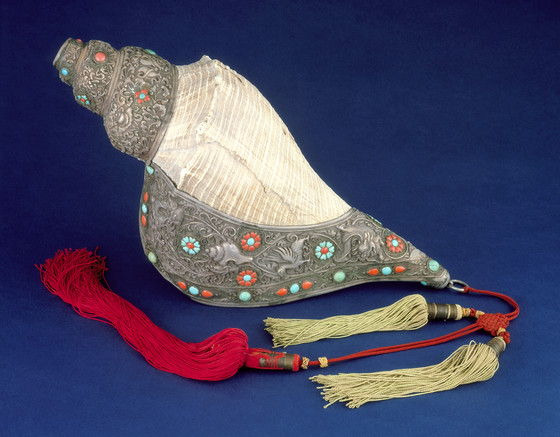
Ritual Conch Trumpet
* Nearly 20,000 images of artworks the museum believes to be in the public domain are available to download on this site. Other images may be protected by copyright and other intellectual property rights. By using any of these images you agree to LACMA's Terms of Use.

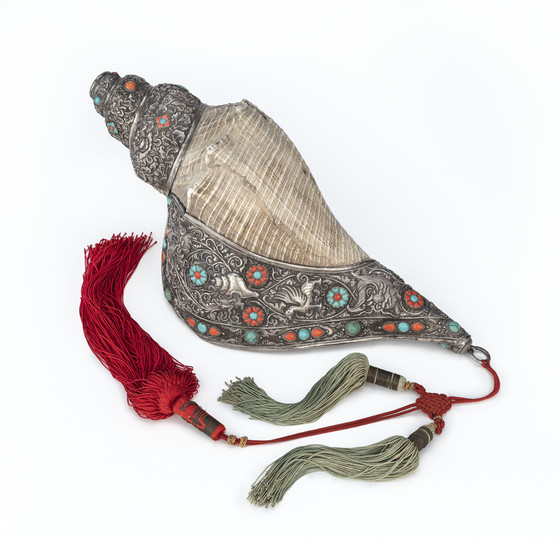
Ritual Conch Trumpet

Eastern Tibet or Mongolia, 18th century
Tools and Equipment
Shell with silver fittings inlaid with coral, jade, and turquoise; silk tassels
36 × 8 1/4 × 4 1/2 in. (91.44 × 20.96 × 11.43 cm) Shell: 15 1/2 × 8 1/4 × 4 1/2 in. (39.37 × 20.96 × 11.43 cm)
Gift of The Michael J. Connell Foundation (M.77.111.2)
Currently on public view:
Resnick Pavilion, floor 1

Since gallery displays may change often, please contact us before you visit to make certain this item is on view.

Curator Notes

...
Tibetan Buddhist art and religious practice are replete with ritual objects held as symbolic attributes by divinities and used by officiating priests and practitioners during various ceremonies intended to alleviate misfortune, increase prosperity, exorcise demonic spirits, or aid in the transcendental journey to enlightenment. When not in ritual use, these ornate sacramental implements are often displayed on elaborate altars along with other ceremonial offerings and images of the Buddha and important deities. Conch shells have two uses in Buddhist rituals. The first is as a container for consecrated water. The second, such as this ornate example, is when they are used as trumpets by cutting the hole in the tip of the spire. The melodious sound of the conch shell represents the pervasive sound of the Dharma, the Buddha’s teachings. It is also believed to drive away evil spirits, so conch trumpets are blown during rituals and beneficial ceremonies. This conch shell is adorned with silver fittings inlaid with coral, jade, and turquoise. The mouthpiece covering the spire is decorated with a scrolling vine and the Eight Auspicious Symbols of Buddhism. Visible in the photograph are the Endless Knot, Lotus, and Pair of Fish. The decorative flange attached to the conch’s aperture has a scrolling vine, Conch Shell (an Auspicious Symbol), and two mythical creatures, a griffin and dragon. For a stylistically related ritual sword, see M.77.111.1.
More...

Bibliography

  • Little, Stephen, Tushara Bindu Gude, Karina Romero Blanco, Silvia Seligson, Marco Antonio Karam. Las Huellas de Buda. Ciudad de México : Instituto Nacional de Antropología e Historia, 2018.
  • Pal, Pratapaditya.  Art of Tibet.  Los Angeles; Berkeley, CA:  Los Angeles County Museum of Art; University of California Press, 1983.
  • Little, Stephen, Tushara Bindu Gude, Karina Romero Blanco, Silvia Seligson, Marco Antonio Karam. Las Huellas de Buda. Ciudad de México : Instituto Nacional de Antropología e Historia, 2018.
  • Pal, Pratapaditya.  Art of Tibet.  Los Angeles; Berkeley, CA:  Los Angeles County Museum of Art; University of California Press, 1983.
  • Pal, Pratapaditya. Art of Tibet. Expanded edition. Los Angeles: Los Angeles County Museum of Art, 1990.
  • Fisher, Robert E.  Art of Tibet.  London:  Thames and Hudson, 1997.
  • McArthur, Meher.  Reading Buddhist Art: An Illustrated Guide to Buddhist Signs and Symbols.  London:  Thames & Hudson, 2002.
More...

Exhibition history

  • Ritual Offerings in Tibetan Art Los Angeles, CA, Los Angeles County Museum of Art, September 13, 2014 - October 25, 2015