...
Milarepa (1040-1123) was a Tibetan master yogi, spiritual poet, and Buddhist saint. He was born in Gungthang in western Tibet into a wealthy family, but a wicked aunt and uncle stole their property. He studied black magic and cast a destructive spell on his evil relatives. Many people were killed and stricken with remorse, Milarepa sought the great Vajrayana teacher Marpa (1012–1097) to teach him how to overcome his vengeful desires. As part of the teaching process, Marpa had Milarepa perform many arduous tasks such as building several towers by hand. In time Marpa imparted his teachings to Milarepa, who then withdrew from human company to devote himself to meditation in solitude. After meditating in a cave for several years he became enlightened. Despite his withdrawal from human company, numerous monks sought his instruction and guidance in their religious studies.
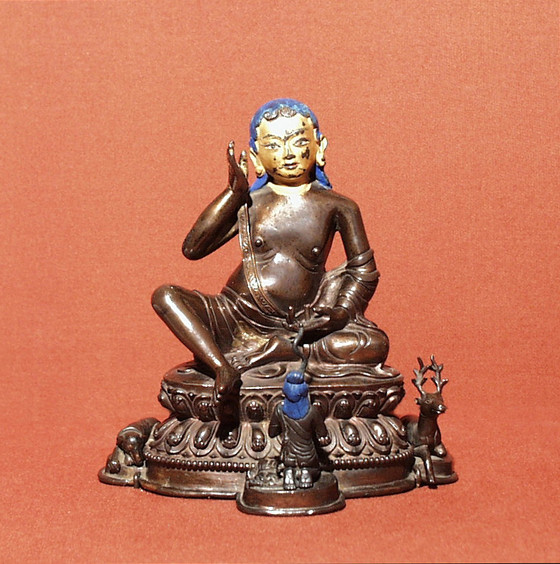
Milarepa wears the simple cotton robes that he reportedly wore even during the coldest winters. His right hand is raised to his ear in a characteristic gesture that has several interpretations: some devotees believe that it signifies his listening to the sounds of nature; while others believe that it might refer to his knowledge of secret oral traditions in the Kagyupa monastic school that were passed verbally from master to disciple. It is also a gesture used by singers and may refer to his singing of his sermons. Milarepa originally held a now-missing skull cup (kapala) with offerings in his left hand. A yoga band is draped across his right shoulder. He is seated on a double lotus base in the relaxed posture (lalita asana) with his right leg pendant. In the front of the base, the hunter Cirarepa who Milarepa converted to Buddhism kneels in reverence. On the sides of the base, are the hunter’s dog laying peacefully and the intended prey, a stag.
See also M.81.90.2 and M.82.165.2. Comparable sculpted portraits of Milarepa are in the Tibet Museum - Fondation Alain Bordier, Gruyères (ABS 347) and University of Michigan Museum of Art, Ann Arbor (1981/2.56).
More...