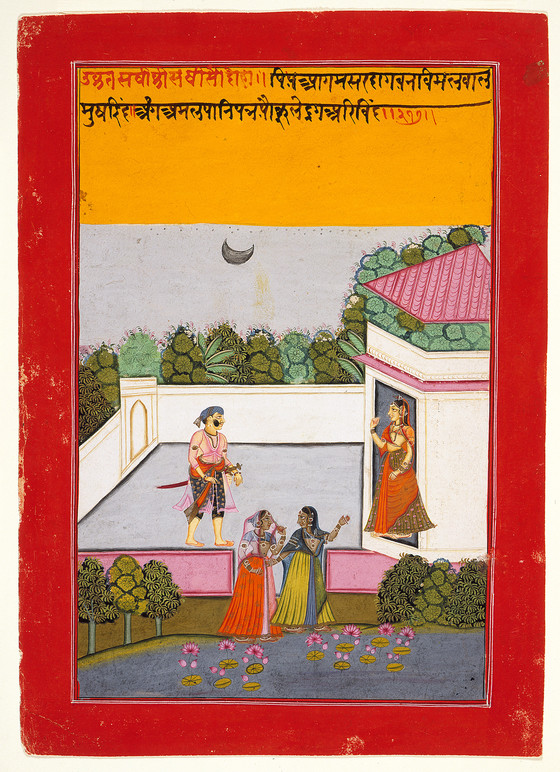
Pleasure at the Lover's Arrival (Madhya Agatapatika), Folio from a Rasraj (King of Sentiment) of Matiram (1603-1693 or 1617-1716)
* Nearly 20,000 images of artworks the museum believes to be in the public domain are available to download on this site. Other images may be protected by copyright and other intellectual property rights. By using any of these images you agree to LACMA's Terms of Use.

Pleasure at the Lover's Arrival (Madhya Agatapatika), Folio from a Rasraj (King of Sentiment) of Matiram (1603-1693 or 1617-1716)

India, Madhya Pradesh, Datia, circa 1770
Drawings; watercolors
Opaque watercolor, gold, silver, and ink on paper
Sheet: 12 7/8 x 9 1/8 in. (32.7 x 23.18 cm); Image: 8 1/8 x 7 in. (20.64 x 17.78 cm)
Gift of the Felix and Helen Juda Foundation (M.72.2.3)
Not currently on public view

Curator Notes

The Rasraj (King of Sentiment) was composed in 1633-1643 in the Hindi dialect of Braj-Bhasa by the poet Matiram (1603-1693 or 1617-1716), who lived in Tikwapur near Kanpur, Uttar Pradesh....
The Rasraj (King of Sentiment) was composed in 1633-1643 in the Hindi dialect of Braj-Bhasa by the poet Matiram (1603-1693 or 1617-1716), who lived in Tikwapur near Kanpur, Uttar Pradesh. It presents idealized portraits of nayikas (heroines) that are intended as representations of emotional states. The nayikas typically yearn to be united with their lovers (nayakas) and their yearning is seen as synonymous with the soul’s quest to unite with the divine. Here, the lover arrives at his lover’s pavilion in the night. The poetic verse inscribed in the header is numbered 217, but the same textual verse is alternatively numbered 220 in Harsha V. Dehejia and Vijay Sharma, Painted Words: Kangra Paintings of Matiram’s Rasraj (D.K. Printworld, New Delhi, 2012), p. 64: When she heard that her beloved had returned from abroad, her face became as radiant as the moon, her body was an ocean of happiness, and her lotus-like eyes opened. A seal stamp on the reverse states that the painting was formerly inventory number 166 in the Datia royal collection, which was dispersed in the 1950s. Two additional folios from this dispersed series are in the Chazen Museum of Art, University of Wisconsin, Madison (2005.1.8 and 2005.1.9). Six more folios are illustrated in Dehejia and Sharma, Painted Words: Kangra Paintings of Matiram’s Rasraj, pp. 182-183. Two more folios are in Simon Ray: Indian & Islamic Works of Art (London 2017), nos. 36-37.
More...