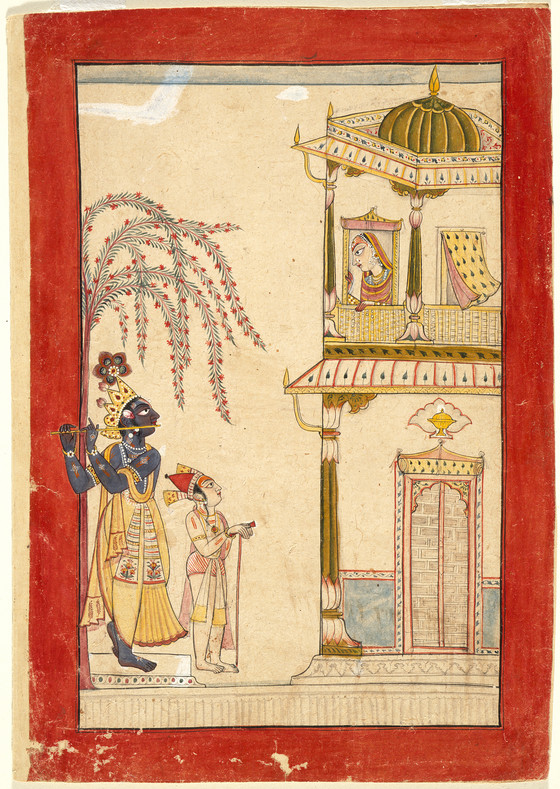
Krishna Serenading Radha, Folio from a Bhagavata Purana (Ancient Stories of the Lord)
* Nearly 20,000 images of artworks the museum believes to be in the public domain are available to download on this site. Other images may be protected by copyright and other intellectual property rights. By using any of these images you agree to LACMA's Terms of Use.

Krishna Serenading Radha, Folio from a Bhagavata Purana (Ancient Stories of the Lord)

India, Jammu and Kashmir, Mankot, circa 1730-1750
Drawings; watercolors
Opaque watercolor and ink on paper
Image: 10 x 6 3/4 in. (25.4 x 17.145 cm); Sheet: 11 3/4 x 8 1/4 in. (29.84 x 20.95 cm)
From the Nasli and Alice Heeramaneck Collection, Museum Associates Purchase (M.72.1.28)
Not currently on public view

Curator Notes

The Bhagavata Purana (Ancient Stories of the Lord) is traditionally ascribed to the legendary poet-sage Vyasa in the 8th-10th century CE....
The Bhagavata Purana (Ancient Stories of the Lord) is traditionally ascribed to the legendary poet-sage Vyasa in the 8th-10th century CE. It stresses the path of devotion (bhakti) to Krishna, the eighth incarnation of Vishnu, the Hindu God of Preservation. The illicit love of Krishna and his married paramour Radha was first recounted in the Bhagavata Purana. Their love story recounts their dalliance in pastoral Vrindavan and, on the spiritual level, is a metaphor symbolizing the soul’s search for union with divinity. When Krishna, the Hindu god of devotion, plays his flute to call Radha and his female devotees (gopis) to dally with him in spiritual bliss, the divine melody disrupts all social strictures and allows the worshipper to aspire freely towards enlightenment and religious rapture. Hence, the standard societal mores of marital fidelity and virtuousness can be transcended by Radha without sanction in her romantic quest for Krishna. Here, while Radha peers out the window of her palace room, the blue-skinned Krishna serenades her by playing his flute. Krishna is accompanied by his brother, Balarama, who holds a lotus and a shepherd’s crook. This is a copy of the original painting formerly in the royal collection of Raja Dhruv Dev Chand of Lambagraon, Kangra, Himachal Pradesh. For a finished painting of this composition, albeit with minor variances in Balarama’s posture and the architectural details, see AC1994.59.1.
More...

Bibliography

  • Rosenfield, John.  The Arts of India and Nepal: The Nasli and Alice Heeramaneck Collection.  Boston:  Museum of Fine Arts, Boston, 1966.