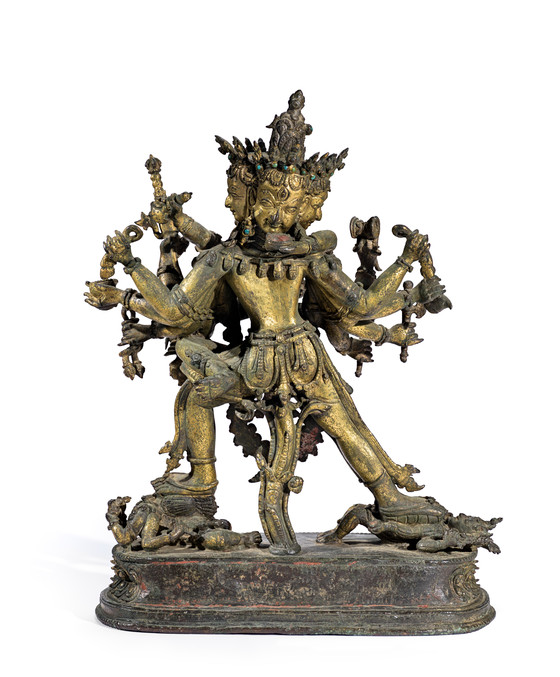
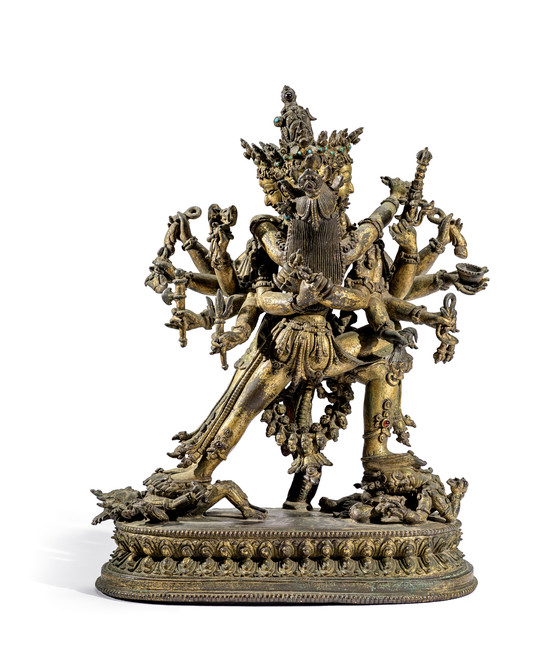
Chakrasamvara and Vajravarahi
* Nearly 20,000 images of artworks the museum believes to be in the public domain are available to download on this site. Other images may be protected by copyright and other intellectual property rights. By using any of these images you agree to LACMA's Terms of Use.

Chakrasamvara and Vajravarahi

Nepal, late 14th-early 15th century
Sculpture
Gilt copper inlaid with gemstones
9 1/2 x 7 1/2 x 3 1/2 in. (24.13 x 19.05 x 8.89 cm)
The Phil Berg Collection (M.71.73.131)
Currently on public view:
Resnick Pavilion, floor 1

Since gallery displays may change often, please contact us before you visit to make certain this item is on view.

Curator Notes

In Tantric meditation, images such as this Nepalese sculpture serve as visualization tools for the meditative practices, in which the practitioner realizes his or her own identity as the fully enlight...
In Tantric meditation, images such as this Nepalese sculpture serve as visualization tools for the meditative practices, in which the practitioner realizes his or her own identity as the fully enlightened Buddha. Each symbolic nuance of the intensely detailed iconography must be completely internalized, to the point that it becomes second nature during the meditations. This process cultivates of mental awareness to realize the absolute truth: the emptiness of all phenomena. It is the blissful nondual union of Chakrasamvara and Vajravarahi that metaphorically symbolizes this enlightened state. This exquisite sculpture of the Chakrasamvara and Vajravarahi perfectly captures the bliss of the enlightened mind. Chakrasamvara is shown with his usual iconography of twelve arms, indicating the twelve-fold chain of causation in the phenomenal world. Vajravarahi blissfully looks up into Chakrasamvara’s face, offering him a skull-cup filled with purified ambrosia with her left hand, and holding a flaying knife, symbolizing the severing of conceptual thought with her left. Their dynamic, passionate energy in perfect union is further articulated by their lunging stance as they dance atop the bodies of the emaciated Kalaratri and the fierce Bhairava. Indeed, works of comparable quality continue to be commissioned by the initiated members of the Newar community even today, and equally skilled craftsmen have kept alive the knowledge of the aesthetic and iconographic requirements necessary to capture the abstract nature of the enlightened mind.
More...

Bibliography

  • Little, Stephen, Tushara Bindu Gude, Karina Romero Blanco, Silvia Seligson, Marco Antonio Karam. Las Huellas de Buda. Ciudad de México : Instituto Nacional de Antropología e Historia, 2018.
  • Little, Stephen, and Tushara Bindu Gude. Realms of the Dharma: Buddhist Art across Asia. Los Angeles: Los Angeles County Museum of Art, 2025.
  • Little, Stephen, Tushara Bindu Gude, Karina Romero Blanco, Silvia Seligson, Marco Antonio Karam. Las Huellas de Buda. Ciudad de México : Instituto Nacional de Antropología e Historia, 2018.
  • Little, Stephen, and Tushara Bindu Gude. Realms of the Dharma: Buddhist Art across Asia. Los Angeles: Los Angeles County Museum of Art, 2025.
  • Berg, Phil. Man Came This Way: Objects from the Phil Berg Collection. Los Angeles: Los Angeles County Museum of Art, 1971.
  • Matilsky, Barbara C.  Buddist Art and Ritual from Nepal and Tibet.  Chapel Hill: Auckland Art Museum, University of North Carolina, 2001.
  • Maxwell, Gail.  Visual Art for Meditation:  Resource Book.  Los Angeles: Museum Associates/Los Angeles County Museum of Art, 2005.
More...