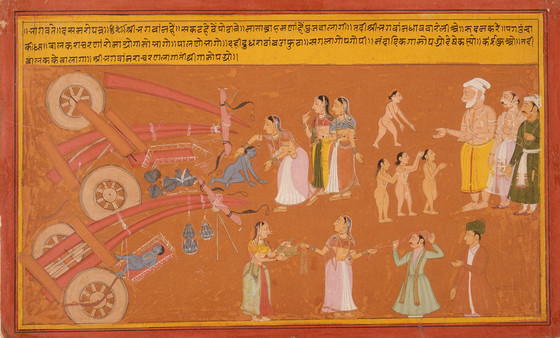
Krishna Breaks the Cart, Folio from a Bhagavata Purana (Ancient Stories of the Lord)
* Nearly 20,000 images of artworks the museum believes to be in the public domain are available to download on this site. Other images may be protected by copyright and other intellectual property rights. By using any of these images you agree to LACMA's Terms of Use.

Krishna Breaks the Cart, Folio from a Bhagavata Purana (Ancient Stories of the Lord)

India, Rajasthan, Mewar, Udaipur, circa 1725
Drawings; watercolors
Opaque watercolor, gold, and ink on paper
Sheet: 10 1/8 x 16 1/2 in. (25.72 x 41.91 cm); Image: 7 1/2 x 15 in. (19.05 x 38.1 cm)
Gift of Tom Juda (M.71.17)
Not currently on public view

Curator Notes

The Bhagavata Purana (Ancient Stories of the Lord) is traditionally ascribed to the legendary poet-sage Vyasa in the 8th-10th century CE....
The Bhagavata Purana (Ancient Stories of the Lord) is traditionally ascribed to the legendary poet-sage Vyasa in the 8th-10th century CE. It stresses the path of devotion (bhakti) to Krishna, the eighth incarnation of Vishnu, the Hindu God of Preservation. To fulfill his role as the guardian of the world and savior of humanity, Vishnu appears as a succession of heroic animals and semi-mortal saviors, called avatars, through which he intervenes in times of crisis or unrighteousness. One day while Krishna’s foster-mother Yashoda was engaged in baby Krishna’s bathing ceremony (utthana) and offering clothing and refreshments to the Brahmins, she had placed the sleeping three-month old infant in a cradle on a cart. When Krishna awoke, he began to cry and kick his feet. The cradle and cart were shattered by his kicking and the pots of milk were spilt. The other children, Yashoda, and Nanda, Krishna’s foster-father, were all astonished by the cart’s destruction and wondered if a demon had destroyed it. Here, in continuous narration starting in the lower sequence, Krishna sleeps in the cart while Yashoda attends to the Brahmans. Above, Krishna breaks the cart while Nanda and the other villagers look on in amazement (Bhagavata Purana 10:7:4-12). The Sanskrit text in the header identifies the episode. A folio from a comparable Mewar Bhagavata Purana series is in the Brooklyn Museum (1991.180.10).
More...