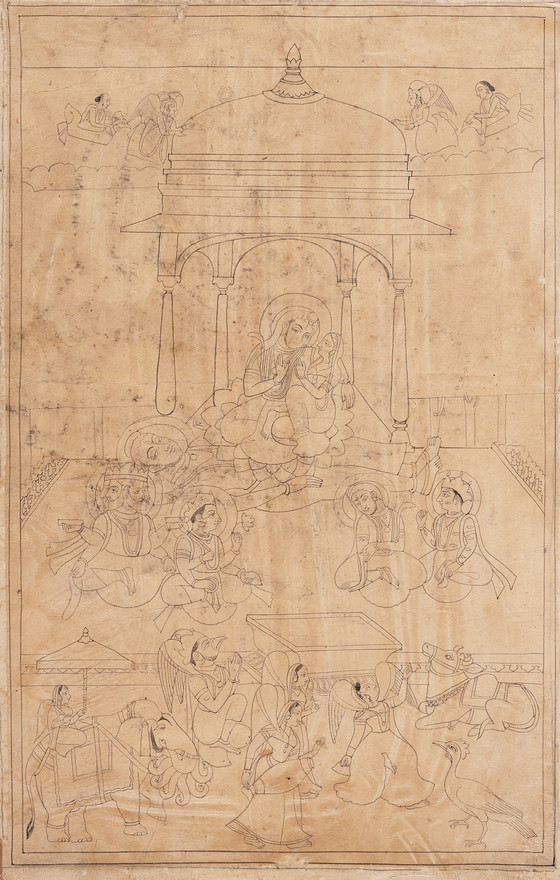
Shiva, Parvati, and Other Deities Watching a Celestial Dance Performance
* Nearly 20,000 images of artworks the museum believes to be in the public domain are available to download on this site. Other images may be protected by copyright and other intellectual property rights. By using any of these images you agree to LACMA's Terms of Use.

Shiva, Parvati, and Other Deities Watching a Celestial Dance Performance

India, Rajasthan, Mewar, circa 1775-1800
Drawings
Pencil on paper
Image: 11 5/8 x 7 1/4 in. (29.52 x 18.41 cm); Sheet: 12 3/4 x 8 1/8 in. (32.38 x 20.63 cm)
Gift of Doris and Ed Wiener (M.70.58.2)
Not currently on public view

Curator Notes

The Hindu god Shiva and his wife Parvati are enthroned in a pavilion on a palace. The nimbate Shiva has his third eye of wisdom (jñananetra), ascetic’s long hair (jatas), and a cobra necklace....
The Hindu god Shiva and his wife Parvati are enthroned in a pavilion on a palace. The nimbate Shiva has his third eye of wisdom (jñananetra), ascetic’s long hair (jatas), and a cobra necklace. He has two arms. His right hand is held in the symbolic gesture of ‘discourse’ (vitarka mudra). His left arm is around the shoulders of Parvati, who holds her hands together in veneration. The divine couple sit on a lotus base atop a large supine Shiva representing the passive supreme principle (purusha) of Hindu Samkhya philosophy. Seated in front of the divine couple are the four-headed Brahma, the four-armed Vishnu, Shiva, and the thousand-eyed Indra. The gods’ mounts are in the foreground: Airavata, the multi-trunked elephant (Indra); the half-avian Garuda (Vishnu); the bull Nandin (Shiva); and the gander (Brahma), which is curiously depicted as a female chicken. Celestial nymphs (apsarasas) dance and play music between the mounts. In the sky, gods in ariel chariots (vimanas) and flying celestial nymphs pay homage.
More...