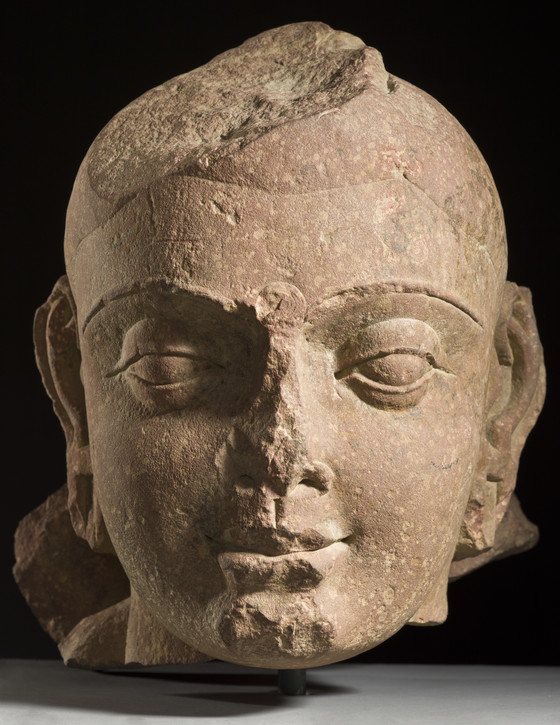
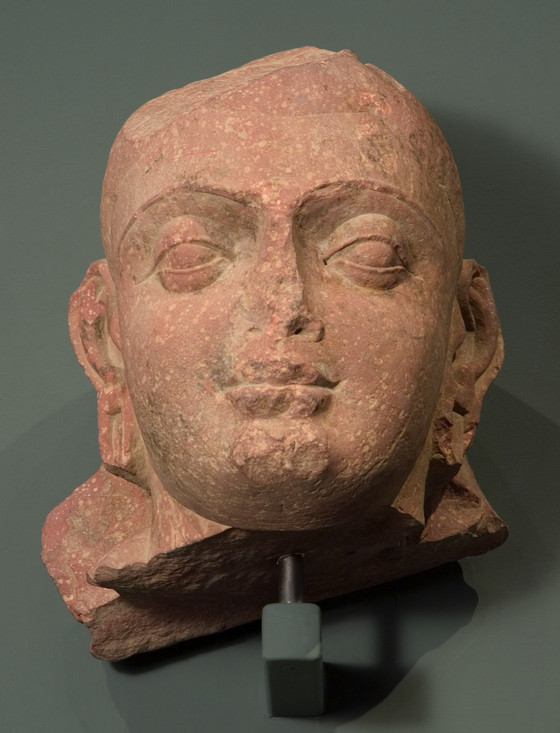
Head of Buddha Shakyamuni
* Nearly 20,000 images of artworks the museum believes to be in the public domain are available to download on this site. Other images may be protected by copyright and other intellectual property rights. By using any of these images you agree to LACMA's Terms of Use.

Head of Buddha Shakyamuni

India, Uttar Pradesh, Mathura, circa 150-200
Sculpture
Mottled red sandstone
14 1/4 x 12 1/2 x 13 1/2 in. (36.19 x 31.75 x 34.29 cm)
From the Nasli and Alice Heeramaneck Collection, Museum Associates Purchase (M.69.13.9)
Not currently on public view

Curator Notes

Staring straight at the viewer, this powerfully rendered head once belonged to an over life-size representation of the historical Buddha Shakyamuni (traditionally dated to 563–483 BCE)....
Staring straight at the viewer, this powerfully rendered head once belonged to an over life-size representation of the historical Buddha Shakyamuni (traditionally dated to 563–483 BCE). His birth name was Siddhartha Gautama. He was born a prince in Lumbini, Nepal, but renounced his royal life to live as a wandering ascetic. After attaining enlightenment at Bodh Gaya, Bihar, he was given the title, Buddha Shakyamuni (The Awakened One, Sage of the Shakya clan). He presented his First Sermon at Sarnath, Uttar Pradesh, and then traveled for more than four decades throughout northern India teaching and establishing a monastic order with monks and nuns. He reached his final enlightenment (mahaparinirvana) when he died in Kushinagara, Uttar Pradesh. The Buddha is portrayed with a now-damaged cranial protuberance that was originally covered by a topknot. It represents his omniscience and enlightened insight. His empty elongated earlobes, distended from wearing heavy gold earrings as a prince, symbolize his abandonment of the mundane world. His closely cropped hair indicates his adoption of ascetic practices after cutting off his long locks worn as a prince. Between his eyes at the bridge of his nose is a small circle known as an urna. Described in texts as a whorl of hair, it is a sacred marking that signifies his prominence and enlightenment.
More...

Bibliography

  • Little, Stephen, Tushara Bindu Gude, Karina Romero Blanco, Silvia Seligson, Marco Antonio Karam. Las Huellas de Buda. Ciudad de México : Instituto Nacional de Antropología e Historia, 2018.
  • Little, Stephen, and Tushara Bindu Gude. Realms of the Dharma: Buddhist Art across Asia. Los Angeles: Los Angeles County Museum of Art, 2025.
  • Little, Stephen, Tushara Bindu Gude, Karina Romero Blanco, Silvia Seligson, Marco Antonio Karam. Las Huellas de Buda. Ciudad de México : Instituto Nacional de Antropología e Historia, 2018.
  • Little, Stephen, and Tushara Bindu Gude. Realms of the Dharma: Buddhist Art across Asia. Los Angeles: Los Angeles County Museum of Art, 2025.
  • Rosenfield, John.  The Arts of India and Nepal: The Nasli and Alice Heeramaneck Collection.  Boston:  Museum of Fine Arts, Boston, 1966.
  • Glynn, Catherine. Aspects of Asian Art from the Los Angeles County Museum of Art. University of Redlands, 1972.
  • Trabold, J. The Art of India, An Historical Profile.  Northridge, CA:  California State University Press, 1975.
  • Pal, Pratapaditya. Indian Sculpture, vol.1. Los Angeles: Los Angeles County Museum of Art; University of California Press, 1986.
More...