Excerpted from Davis, Bruce. Master Drawings in the Los Angeles County Museum of Art. Los Angeles: Los Angeles County Museum of Art, 1997, 22–23.
...
Excerpted from Davis, Bruce. Master Drawings in the Los Angeles County Museum of Art. Los Angeles: Los Angeles County Museum of Art, 1997, 22–23.
Pino studied initially in Siena with Domenico Beccafumi. By 1544 he was in Rome, where he was elected to the Accademia di San Luca and where he soon joined the group of artists working under the supervision of Perino del Vaga, decorating the Castel Sant’Angelo for Pope Paul III. In 1557 he was living in Naples, where he remained for about a decade. Thereafter he traveled frequently between Rome and Naples. Among his late works are paintings in Rome in the Oratorio del Gonfalone and in the churches of Santa Maria in Aracoeli and Santa Maria della Concezione.
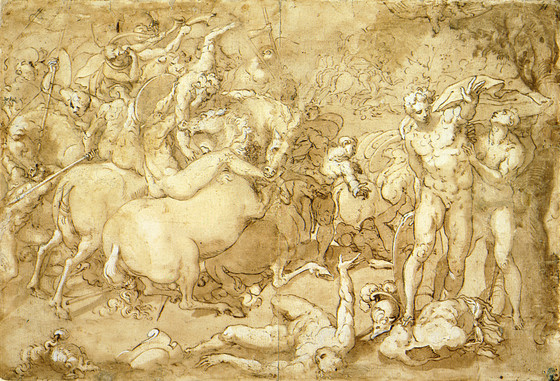
This sheet was formerly attributed to Taddeo Zuccaro, but the present attribution to Pino was suggested by John Gere and Philip Pouncey at the time of its acquisition (letters, departmental files). The subject has traditionally been called the Battle of Anghiari, but there is no compelling visual evidence to indicate what specific battle is represented. The depiction of the battle of Anghiari is known in the history of art essentially via Leonardo da Vinci’s destroyed painting of the subject formerly in the Palazzo Vecchio in Florence. Indeed, Pino’s representation of the soldiers as nudes has more in common with Michelangelo’s cartoon The Battle of Cascina, also commissioned by the Florentine Republic for the Palazzo Vecchio. The interest in battle scenes in the Italian Renaissance was undoubtedly inspired by representations of battling figures on ancient Roman sarcophogi.1 The drawing may be related, at least in its general subject, to Pino’s fresco The Assault on Pera of 1546–47 in the Sala Paolina in the Castel Sant’Angelo.2 Both compositions feature wildly gesticulating figures in the foreground; each scene is bisected diagonally.
A drawing similar in theme and composition, with the same striding and gesturing man in the foreground, is in the Albertina, traditionally attributed to Beccafumi but now classified as Sienese, sixteenth century.3
Notes
1. For a brief discussion of the theme in the context of Domenico Campagnola’s engraving Battle of Nude Men, see Bruce Davis, Mannerist Prints: International Style in the Sixteenth Century, exh. cat. (Los Angeles: Los Angeles County Museum of Art, 1988), 68–69.
2. Filippa M. Aliberti Gaudiosi, Gli affreschi di Paolo III a Castel Sant’Angelo: Progetto ed esecuzione 1543–1548, exh. cat. (Rome: Museo Nazionale di Castel Sant’Angelo, 1981), 1: 163, pl. 11. Another brown ink and wash drawing by Pino for one of the Sala Paolina frescoes, Alexander the Great and the High Priest of Jerusalem, is in the Uffizi; see ibid., 2: 138–39, no. 86.
3. Veronika Birke and Janine Kertész, Die italienischen Zeichnungen der Albertina: Generalverzeichnis, Band 1. Inv. 1–1200 (Vienna: Böhlau Verlag, 1992), 165, no. 280.
More...