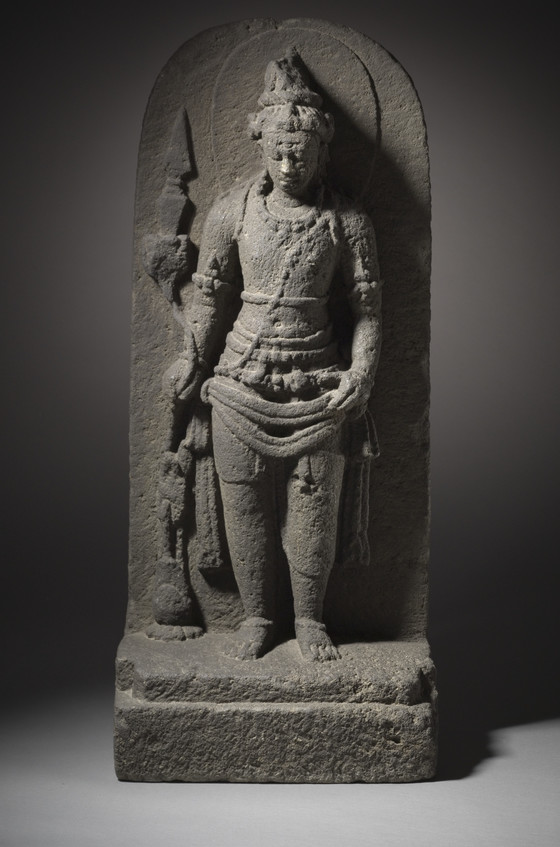
Indra, Chief of the Gods
* Nearly 20,000 images of artworks the museum believes to be in the public domain are available to download on this site. Other images may be protected by copyright and other intellectual property rights. By using any of these images you agree to LACMA's Terms of Use.

Indra, Chief of the Gods

Indonesia, Central Java, 9th century
Sculpture
Volcanic stone
33 3/4 x 14 1/2 x 11 3/4 in. (85.73 x 36.83 x 29.85 cm)
Los Angeles County Fund (60.52.2)
Not currently on public view

Curator Notes

...
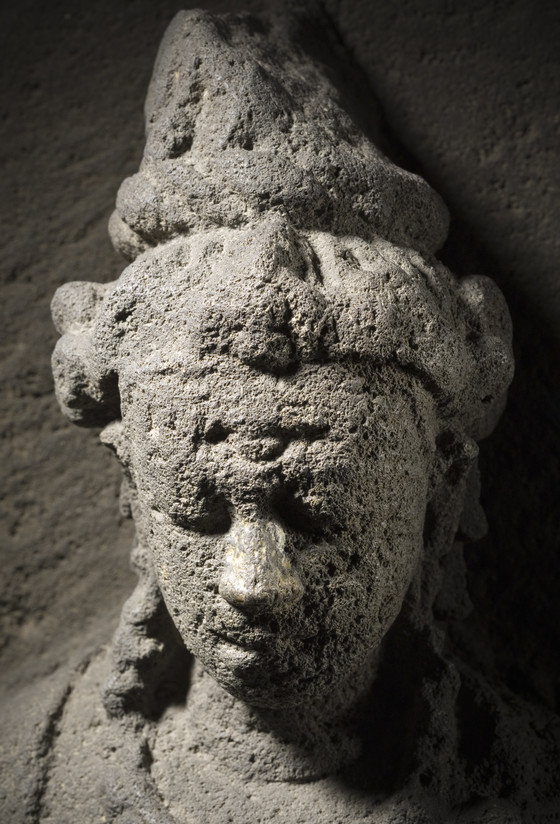
Like his Norse counterpart, Thor, the Vedic (proto-Hindu) deity Indra, was considered the god of lightning and thunder, and was intimately associated with the life-giving monsoonal rains. In this rare and possibly unique extant Central Javanese image of Indra (Brown 2008, 86-87), he can be identified by his primary attribute of the thunderbolt (vajra) that is positioned vertically on top of a lotus growing out of a vase beside his right foot, and by the horizontal eye on his forehead. His right hand holds the lotus stock and his left hand rests on his hip. He is nimbate, crowned, and wears profuse jewelry, including the Brahmanical sacred thread (yajnopavita) worn over his left shoulder. In addition to his religious role as the king of the gods, Indra also served an auxiliary function as a directional guardian (dikpala) in which he was the Divine Regent of the East (see M.2013.57a-b). In this context, the image may have been erected in a subsidiary shrine devoted to the directional guardians.
More...

Bibliography

  • Brown, Robert L. "Selections From the Southeast Asian Art Collection of the Los Angeles County Museum of Art." Arts of Asia 38 (3): 75-87 (May-June 2008)